


Fund capital buying half of Portland metro apartments [9/18/26]
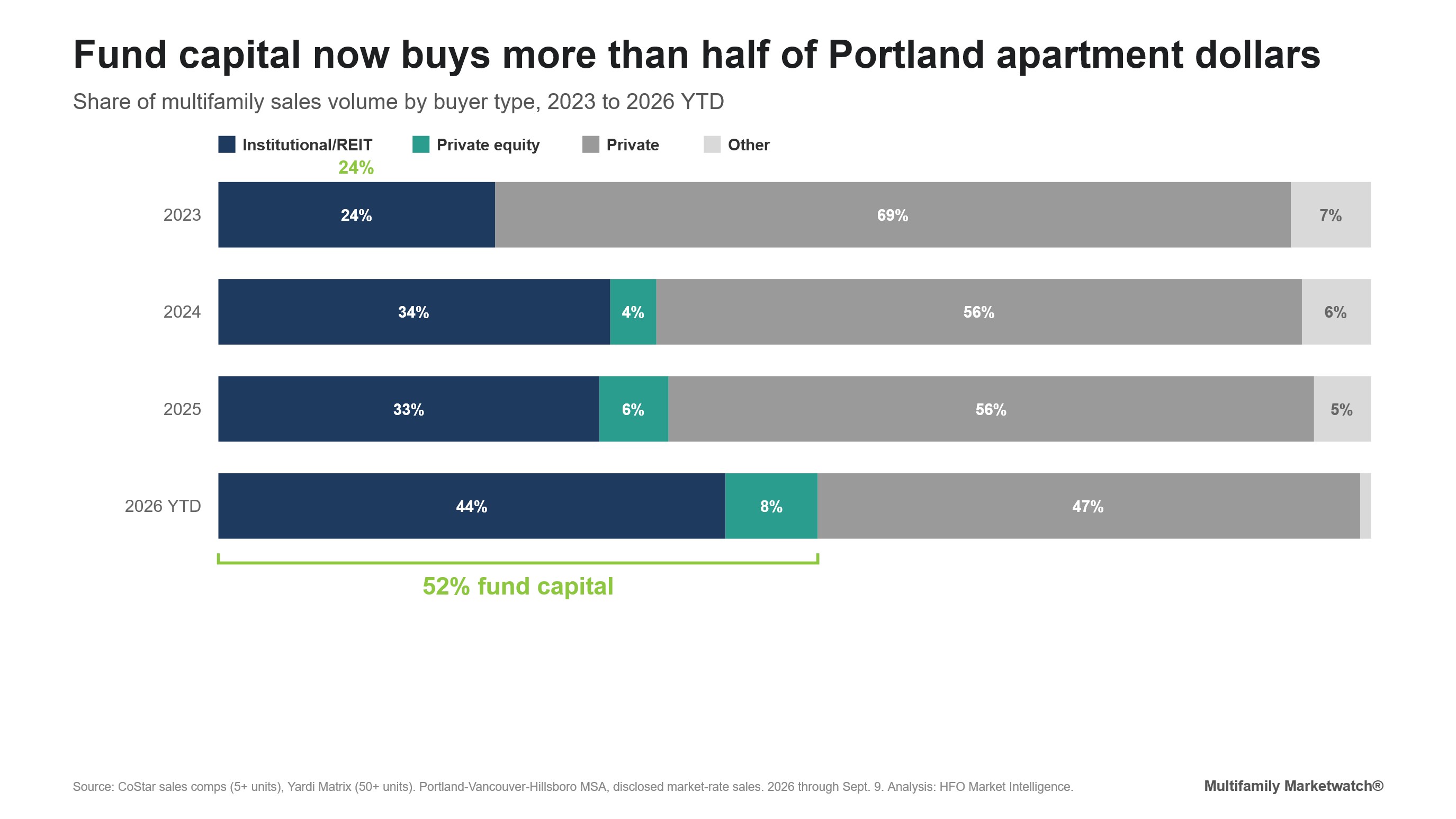
Institutional, REIT and private equity buyers have gone from less than a quarter of Portland apartment dollar volume in 2023 to just over half so far in 2026. Private owners have been net sellers every year of the period. They have unloaded about $1.1 billion more than they bought. On the other side of those trades is increasingly a fund. In 2026, for the first time since the rate shock, it is a public REIT.

The numbers
Institutional and REIT buyers
Private equity, tracked separately by CoStar, made no purchases in 2023. Then it bought $78 million in 2024, $93 million in 2025 and $106 million so far in 2026. It has been a net buyer three years running. The tally does not yet include Grand Peaks and PCCP's September purchase of the 424-unit West End District in Beaverton. However, the price for that deal has not been published.
Combined fund capital (institutional, REIT and private equity) accounts for 51% of dollar volume in 2026, up from 24% in 2023.
Private buyers still do most deals by count (101 of 151 disclosed sales this year), but their share of dollars has fallen from 69% in 2023 to 47% in 2026. They have been net sellers of $149 million, $326 million, $267 million and $370 million in each successive year.
How the story unfolded
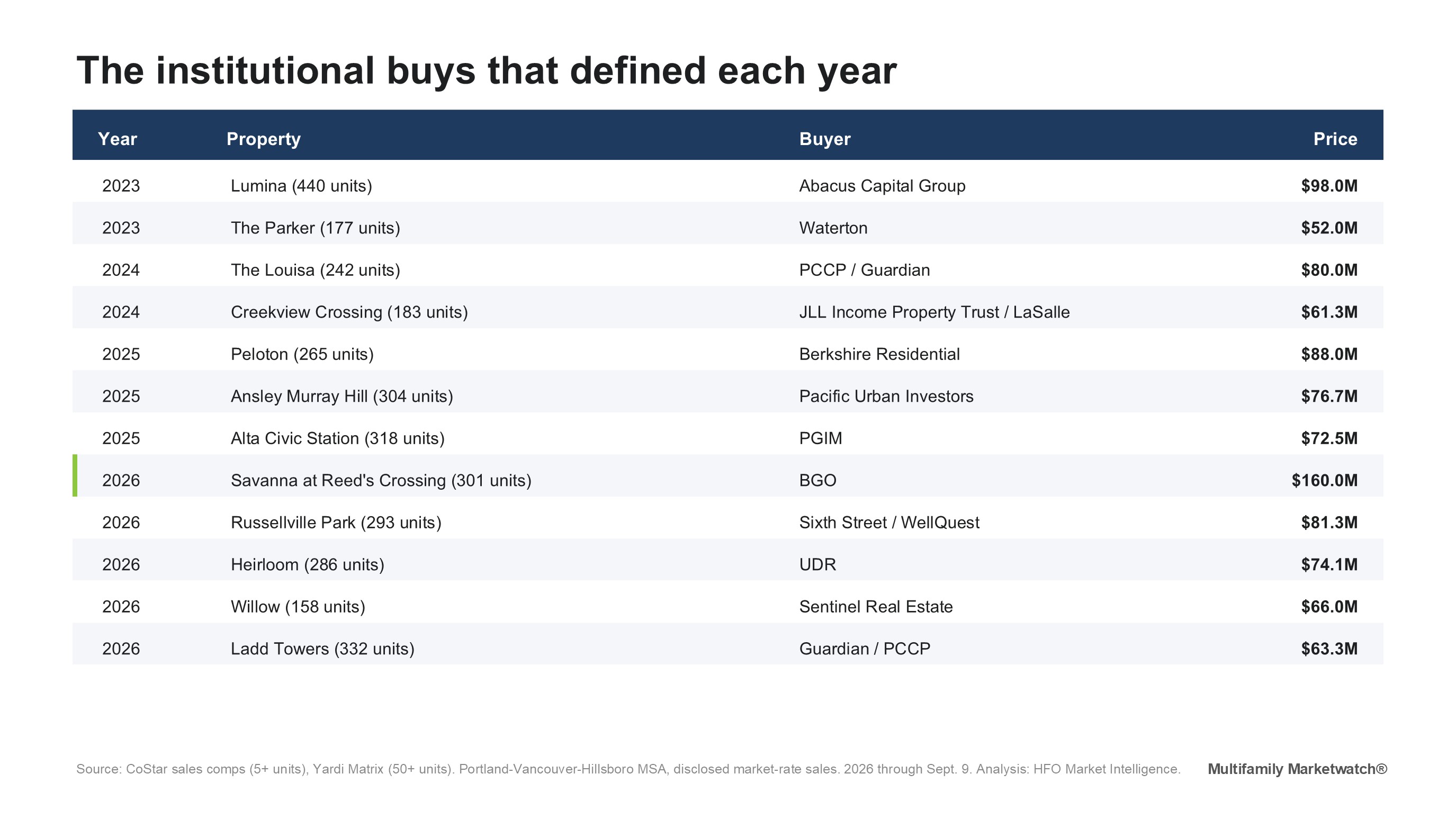
2023: Private capital holds the market together. With rates rising and deal volume at a decade low, private buyers accounted for 89 of 126 disclosed sales and more than two-thirds of the dollars. Institutional activity was thin: 15 deals, and two of them (Abacus Capital’s $98 million purchase of Lumina and Waterton’s $52 million purchase of The Parker) made up 60% of institutional dollars. UDR, the only publicly traded apartment REIT in the data, was a seller. It exited The Arbory in Hillsboro for $78.6 million in December.
2024: Institutions come back.
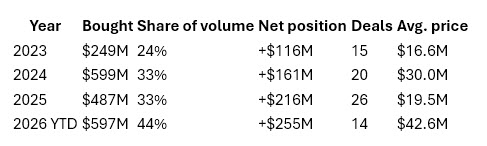
Institutional purchases more than doubled to $599 million on 20 deals. PCCP and Guardian paid $80 million for The Louisa. JLL Income Property Trust, advised by LaSalle, paid $61.3 million for Creekview Crossing. FPA Multifamily paid $54 million for ReNew at Cornell. DRA Advisors paid $48.8 million for The Arden. Institutions bought 13 properties of 100 units or more, up from two the year before. Nevertheless, institutions also sold $438 million (J.P. Morgan, CapitaLand, Invesco), so their net position was a moderate $161 million. Private buyers had their biggest year in the study at nearly $1 billion. This was led by MG Properties’ $91 million Emerald Place. In addition, private equity showed up for the first time with Harrison Street’s $78 million stake in NV Portland.
2025: Broader, smaller, steadier.
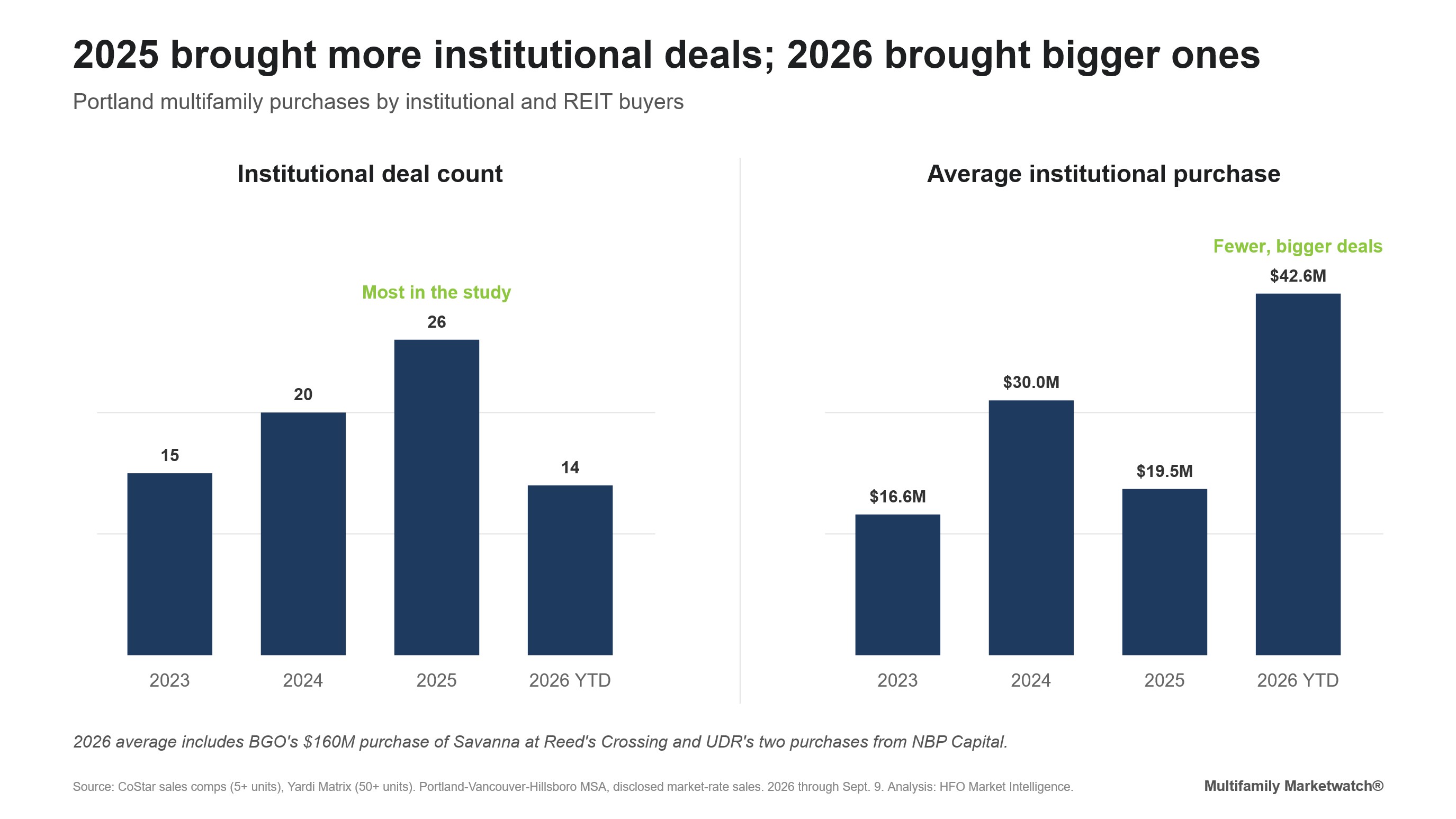
Institutional deal count rose to 26, the most in any year studied. However, the average deal shrank to $19.5 million as buyers like FPA, Fourth Avenue Capital and Blackhawk Capital worked the 30-to-150-unit range.
The big trades were still there: Berkshire Residential paid $88 million for Peloton. Also, Pacific Urban Investors paid $76.7 million for Ansley Murray Hill and PGIM paid $72.5 million for Alta Civic Station. Net institutional buying rose to $216 million.
For the first time, institutions outspent private buyers on 100-plus-unit assets, $379 million to $343 million.
Total disclosed volume fell from 2024. Therefore, the shift in mix was not a function of a bigger market.
Instead, institutions took a larger slice of a smaller pie.
2026 year to date: The breakout.
With more than three months left in the year, institutional purchases have already matched all of 2024 at $597 million. This was on just 14 deals averaging $42.6 million. BGO paid $160 million for Savanna at Reed’s Crossing, the largest single-asset sale in the period. Sixth Street and WellQuest paid $81.3 million for Russellville Park. Sentinel paid $66 million for Willow in Lake Oswego. And UDR, the REIT that sold out of The Arbory in 2023, came back as a buyer. It paid $53.4 million for Meetinghouse in April and $74.1 million for Heirloom in July. Both acquisitions were from NBP Capital. Net institutional buying of $255 million is the highest in the study. Institutions also sold $341 million. Several of the biggest trades were institution to institution: Guardian and PCCP bought Ladd Towers from Invesco. Also, FPA bought Cyan/PDX from Nuveen. Private equity stayed steady, including Bridge Investment Group’s $50.1 million River Ridge, Benedict Canyon’s $27.3 million Fieldstone, and Focus Healthcare’s $29 million Courtyard Village.
What it means
Three takeaways for owners and investors.
-
First, the buyer pool for larger Portland assets has changed. A 150-unit-plus property that would have drawn mostly private and 1031 buyers in 2023 now competes for institutional and fund attention, and the winning bids in 2026 are coming from BGO, UDR, Sentinel, Sixth Street, and PGIM.
-
Second, private sellers are supplying that inventory. Cumulative net selling by private owners since 2023 is about $1.1 billion, and 2026 is on pace to be the largest year of private outflow yet. Much of that is a long-held product changing hands as owners take advantage of renewed demand for scale.
-
Third, the return of publicly traded REIT capital is new. No listed apartment REIT appears as a Portland buyer in 2023, 2024, or 2025 (non-traded REITs did buy RealtyMogul in 2023 and JLL Income Property Trust in 2024). UDR’s two purchases this year total $127.5 million, and they were made from a developer, not another institution, which suggests the REIT saw value at delivery rather than waiting for a distressed seller.
Methodology notes
Classes
-
Buyer and seller classes are CoStar’s “true type” tags as exported. Where CoStar lists mixed types (for example, “Private | Institutional”), the deal is counted as institutional if any party is institutional or public, then private equity, then private. CoStar tags some large national operators, including Greystar, MG Properties, and Kennedy Wilson, as private; “private” in this analysis means non-fund capital, not small local owners. Two CoStar records were reclassed on Yardi Matrix evidence: Creekview Crossing (2024) from private to institutional, because Yardi names LaSalle Investment Management as buyer, and Gateway Plaza (2023) from institutional to private, because Yardi names Brightview Capital.
Yardi Matrix
-
Yardi Matrix tracks sales of 50 units or more. Of 146 Yardi sales in the period, 127 matched CoStar records by address and date. Twelve unmatched sales that could be confirmed as real transactions were added, including UDR’s Meetinghouse and Heirloom purchases, both confirmed by Multi-Housing News, and DRA Advisors’ purchase of The Arden. Where both sources report a price, they agree within 3% on all but four sales; the largest gap is Harbor Sky (Yardi $61 million, CoStar $52.5 million), where CoStar’s figure is used.
Dollar Figures Used
-
Dollar figures use disclosed prices only. About 6% of transacted units in 2023 and 4% in 2024 had no disclosed price, rising to 15% in 2025 and 13% in 2026. Three CoStar entries dated Sept. 2, 2025 show Apollo Global Management acquiring 950 units from Bridge Investment Group with no price. That date matches the close of Apollo’s all-stock purchase of Bridge as a company, so these are ownership roll-ups, not property sales, and they are excluded. The adjusted set also removes 10 LIHTC tax-credit transfers, three recapitalizations, five partial-interest transfers, five same-party transfers, one duplicate record, and nine sales priced under $50,000 per unit. Including those transactions raises the 2025 institutional net to $467 million, driven by a $200 million tax-credit portfolio, but does not change the direction of any trend. Fifteen undated CoStar records that appeared identically in both exports were excluded. The first 2023 sale in CoStar is dated Jan. 27; a separate pull confirmed no sales were recorded Jan. 1 through Jan. 26, 2023.
#MultifamilyMarketwatch® #Multifamily #PortlandRealEstate #ApartmentInvesting #CRE
About HFO
HFO Investment Real Estate is the largest multifamily-only brokerage in the Pacific Northwest. The company has 12 brokers focused exclusively on apartment investment sales in Oregon and Washington. Call (503) 241-5541.
- Subscribe to HFO’s Oregon & SW Washington Weekly Newsletter for Multifamily Owners, Investors & Developers on LinkedIn.
- Subscribe to HFO’s Washington State Weekly Newsletter for Multifamily Owners, Investors & Developers on LinkedIn.
- Watch HFO’s latest YouTube interviews and subscribe.
- Click here to read more of our latest investor insights.
- Click here to see many of HFO’s current listings.