


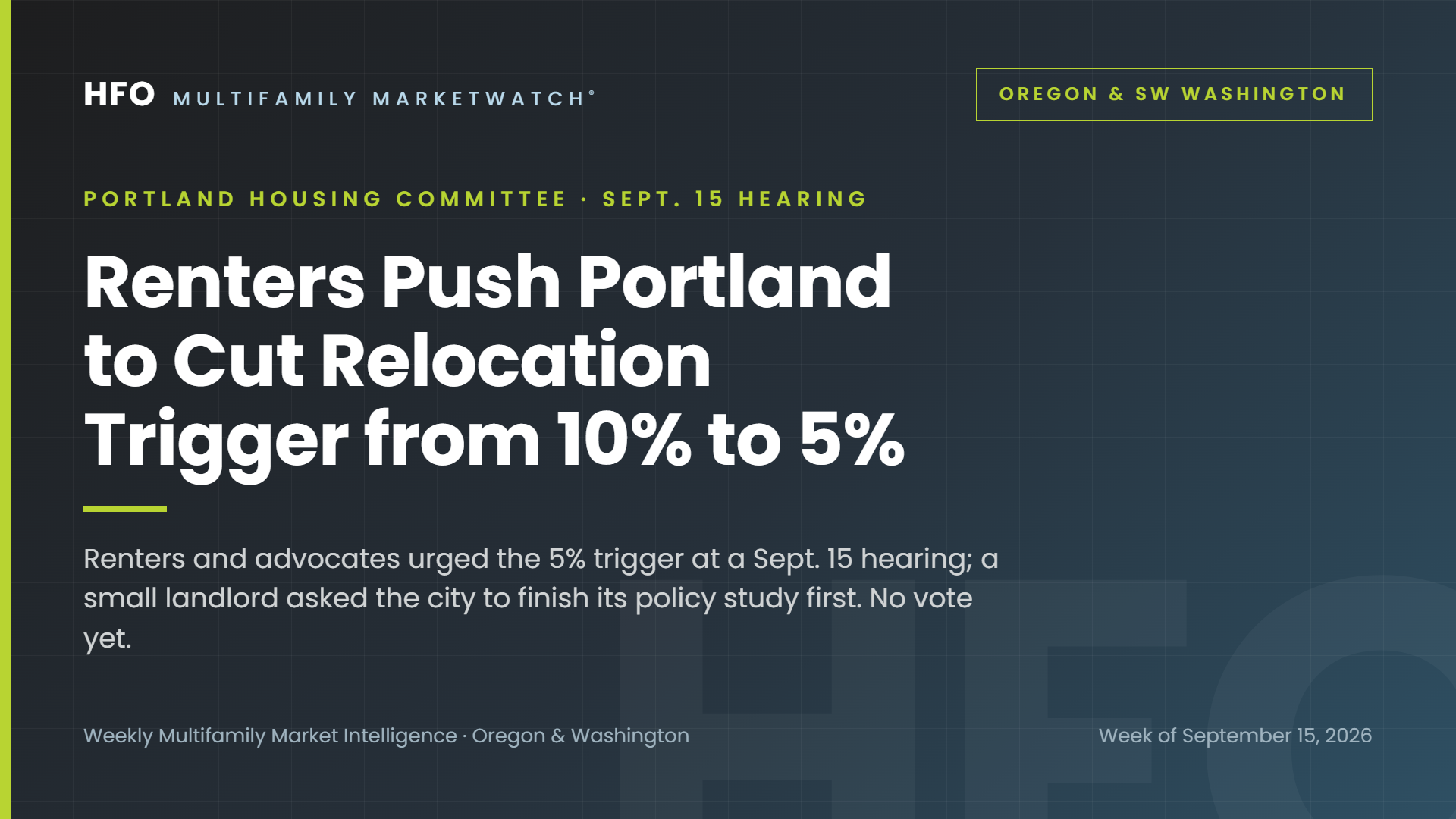
Renters Push Relocation Trigger Adjustment [9/16/26]
Avalos and Green closed the hearing favoring rent control, with little acknowledgment of landlords’ cost concerns.
Portland’s Housing and Permitting Committee spent nearly an hour and a half Sept. 15 hearing directly from renters, a small landlord, and tenant advocates on the city’s rental relocation policy. They also heard about broader housing conditions. This was part of a public hearing the committee plans to repeat in the coming months.
The session, held from 2 p.m. to just before 4 p.m. in City Hall’s Council Chambers, was the fourth item on the committee’s agenda that day. It followed an earlier staff briefing on the city’s Mandatory Relocation Assistance policy, known as RELO. Eleven people signed up to testify. Two more spoke after walking in. Committee Chair Candace Avalos and Vice Chair Mitch Green led the discussion. Furthermore, committee members Tiffany Koyama Lane, Elana Pirtle-Guiney and Steve Novick participated as well.
What happened
RELO requires landlords to pay tenants a set amount, currently ranging from $2,900 for a studio to $4,500 for a unit with three or more bedrooms, when a tenant is displaced by a no-cause termination, certain landlord-initiated terminations, or a rent increase of 10% or more within 12 months. The policy dates to 2017 and has not been changed since. However, Housing Bureau staff told the committee they are beginning a broader evaluation of the city’s landlord-tenant policies. They are working with an outside consultant.
Speakers were divided on whether the 10% rent-increase threshold that triggers RELO payments should be lowered to 5%. Renters, tenant advocates and a District 4 council candidate argued it should. A small landlord who testified by phone asked the committee to wait for the full policy study before making changes.
Limited Speakers
Jamie Evenstar, a District 4 council candidate who said she helped write the original 2017 policy, told the committee the 10% trigger was a political compromise rather than sound economic policy. “A healthy rental market sees an average of 2 to 3% increases in a year,” Evenstar said, adding that her 2017 analysis found increases above 5% to 7% would push the average Portland renter into severe rent burden.
Ben Gilbert, a Portland renter and volunteer lobbyist for the Portland chapter of the Democratic Socialists of America, cited a $7 million antitrust settlement Oregon reached in November 2025 with Greystar Management Services over alleged rent-pricing coordination through algorithmic software. “We need the city to demand the state legislature end their preemption on municipal rent control,” Gilbert said.
A small landlord who identified herself in testimony as Amy Morillo Hudson, a former renter who now rents out a single family home in Northeast Portland, urged the committee not to move ahead of its own data. “Please just fully complete the city’s landlord-tenant policy review before deciding whether to change rental relocation assistance,” she said. She told the committee her fixed ownership costs rose 4.3% last year alone. In addition, she said that a 5% cap on rent increases would leave her little room to keep the unit as a rental rather than sell it.
Councilor testimony and comments
City Councilor Sameer Kanal, who represents District 2, testified as a renter rather than in his capacity as a committee member. He said a lower RELO trigger would mainly affect landlords raising rents fastest. This is because many already keep increases below 5%. “What the policy change like that would do is ultimately affect only the people who are raising it higher, which is the point,” Kanal said. He told the committee his top concern was substandard housing that has gone uninspected by the city for years.
Green, who represents District 4 and chairs the housing committee as vice chair, told testifiers that 53% of his district’s residents are renters, higher than the citywide average. In addition, about half of those renters are rent-burdened.
He questioned the premise of rental property as a retirement investment. “The only way that works out is if you’re betting on the speculative price increase of housing over time and a pretty high cap rate,” Green said.
He argued renters, not landlords, absorb the cost when rent growth outpaces inflation: “If you have to raise rents faster than the rate of inflation, then you’re taking it from someone else who has earned a wage to pay that rent.”
Green’s Socialism Takes the Fore
Green closed his remarks by quoting economist Adam Smith’s “The Wealth of Nations”: “The landlords, like all other men, love to reap where they never sowed, and demand a rent even for its natural produce.” He called for “strong tenant protections, rent control, and a pro-housing-production agenda that has social housing at its core.”
Avalos, who represents District 1, announced a new series of outreach events she called “Rental Rip-Offs,” planned for November across the city, to gather additional renter feedback beyond rent levels. These will include maintenance and retaliation concerns. She cited a constituent who told her a landlord relocated them rather than address a rodent complaint. Furthermore, Avalos said the committee’s next meeting is scheduled for Oct. 6 and will include a staff presentation on climate and health standards policy. This will be along with three action items: a housing finance measure, an ordinance aligning city code with state land use law, and the Central City 2035 plan. She said the committee expects to continue that agenda into its second October meeting.
The morning after Green launched an attack on capitalism, a feature story about his 10,000+ deleted tweets appeared in The Oregonian/Oregonlive: “Resurfaced Tweets Show Portland Councilor’s Pure Hatred for the Portland Police.” According to the Oregonian, his tweets made dozens of provocative public statements between 2020 and 2021 on what was then Twitter, where he also appeared to make thinly veiled threats about landlords and billionaires, trash July 4 celebrations, and hurl a variety of other invective, according to archived copies online. According to his social media posts, Green repeatedly called for eliminating policing entirely, saying at one point “cops are simply incompatible with peaceful society.” At other times, he referred to police officers as “absolute monsters,” “bastards” and “infamously cowardly.”
Where it goes from here
Housing Bureau staff told the committee earlier in the meeting that their landlord-tenant policy evaluation, conducted with the consulting firm Stout, is still in its design phase and is not expected to produce recommendations until later phases of the contract, which was still being finalized as of the meeting. Staff said the evaluation will examine RELO alongside the city’s other landlord-tenant policies. This includes a 2022 Rental Services Commission recommendation to raise and index RELO payment amounts. The council never adopted this recommendation.
The committee did not hold a formal vote after the testimony. Avalos and Green both said the hearing was intended as a starting point for further policy discussion. The November “Rental Rip-Offs” events and the ongoing landlord-tenant policy evaluation are expected to shape what, if any, changes to RELO come before the full council.
A recording of the full Sept. 15 Housing and Permitting Committee meeting is available on the city of Portland’s YouTube channel.
#MultifamilyMarketwatch®
About HFO
HFO Investment Real Estate is the largest multifamily-only brokerage in the Pacific Northwest. The company has 12 brokers focused exclusively on apartment investment sales in Oregon and Washington. Call (503) 241-5541.
- Subscribe to HFO’s Oregon & SW Washington Weekly Newsletter for Multifamily Owners, Investors & Developers on LinkedIn.
- Subscribe to HFO’s Washington State Weekly Newsletter for Multifamily Owners, Investors & Developers on LinkedIn.
- Watch HFO’s latest YouTube interviews and subscribe.
- Click here to read more of our latest investor insights.
- Click here to see many of HFO’s current listings.