


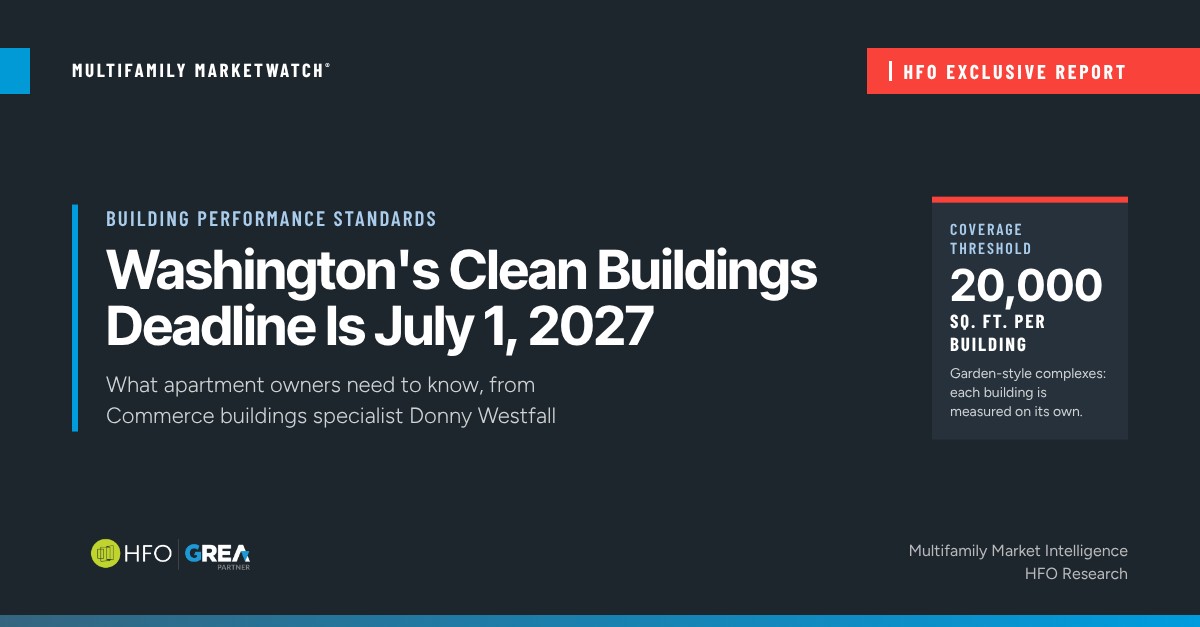
Washington’s July 1 Owner Deadline for Clean Buildings [11/3/26]
Washington’s Clean Buildings Deadline Is July 1, 2027. Here Is What Apartment Owners Need to Know
By Aaron Kirk Douglas, Director of Market Intelligence, HFO Research
Thousands of Washington apartment owners got a letter from the State Department of Commerce telling them their building is covered by the Clean Buildings Performance Standard (CBPS). Many are still asking the same questions: Does my building really qualify? What am I supposed to turn in?
Donny Westfall, a buildings technical specialist with Commerce, answered both in an interview with HFO Investment Real Estate partner Greg Frick for HFO’s Multifamily Marketwatch video series.
The law dates to 2019, when the legislature targeted existing buildings as the state’s second largest source of greenhouse gas emissions after transportation. In 2022, lawmakers expanded it to cover multifamily buildings and smaller commercial buildings. Commerce has identified close to 28,000 covered buildings statewide.
Threshold: 20,000 SF of Gross Floor Area
For apartment owners, the threshold is 20,000 square feet of gross floor area, and every multifamily building above that line is subject to tier two of the CBPS. That holds no matter how large the building is. Tier one buildings must meet energy performance targets, while tier two buildings do not. They report.
The test applies building by building, not to the whole site. Westfall said this scenario is where owners most often get it wrong. Garden-style complexes are the most common example. Commerce built its list of covered buildings using county assessor and commercial real estate data. Those sources often lump several buildings under one square footage figure. An owner who sees a 50,000-square-foot complex on the notice may find that no single building reaches 20,000 square feet. If that is the case, the CBPS does not cover anything in the complex.
Parking and exterior decks do not count toward a building’s gross floor area when determining whether the building is subject to the requirements of the CBPS. Gross floor area is the total square footage measured between the exterior walls of the building. If one building on a site is over the line and the rest are not, only that building must comply with the requirements. However, a master-metered property can choose to report the whole group together.
The first thing to do after getting a letter is log in to Commerce’s Clean Buildings portal and check that the square footage on file matches the building.
Compliance for tier two has three parts. The first is benchmarking energy use through Energy Star Portfolio Manager, a free online tool run by the U.S. Environmental Protection Agency. It links to the state’s portal and can pull data directly from utilities. The CBPS counts all energy used in the building, including electricity, natural gas and bulk fuels. Water is not included.
Owners often worry about getting energy data for units metered in a tenant’s name. Washington law, RCW 19.27A.170, requires utilities to provide owners of covered buildings aggregated whole-building data on request without tenant consent. Larger utilities must automate the feed into Portfolio Manager. In contrast, smaller ones must provide the data in a format that uploads directly. Westfall said the department meets regularly with utilities. Many offer programs that help owners set up benchmarking.
The second part is an energy management plan, and the third is an operations and maintenance program, which is a component of the plan.
Westfall said the best plans read like a standard operating procedure the owner uses, not a template filled out for the state. They set performance goals, name who is responsible for monitoring energy use, and move maintenance from fixing failures to preventing them. The operations and maintenance program inventories building systems and sets maintenance schedules. It also lays out how the owner will plan for capital replacements. Everything that uses energy or affects it is in scope. This includes the building envelope, hot water, ventilation, lighting, and HVAC.
Most of this can be done in-house. “It’s not reinventing the wheel. That’s not the expectation here,” Westfall said. Many owners already have maintenance contracts and some form of preventive maintenance. The work is comparing what is in place against the state’s requirements and filling the gaps.
Submissions for tier two must come from a qualified energy manager. That requires three years of building operations experience or familiarity with the specific building, plus free online training offered through the Smart Building Center in Seattle. Owners and maintenance staff can fill the role.
July 1, 2027 Deadline
The deadline is July 1, 2027, and the state expects all three parts to be complete and in use by then. A rulemaking finished last year added a safety valve. Owners who submit their benchmarking data by the deadline and file an extension application can get two more years to finish the energy management plan and the operations and maintenance program. Westfall’s advice for owners who feel behind: “Get started.” Set up a portfolio manager account, contact the utility, and get the data flowing.
The standard runs on a five-year compliance cycle. When a building sells, the new owner takes on responsibility. An approved compliance application covers the building for the full five years. Therefore, buyers should ask sellers what has been submitted and whether a benchmarking account exists that can be shared. A separate extension is available when a sale falls within 12 months of the deadline.
Washington Clean Buildings · apartment owner decision tree, 3 questions

Three questions settle most cases: whether any single building crosses 20,000 square feet, whether all three compliance parts can be done by July 1, 2027, and if not, whether benchmarking alone can be.
Westfall said the level of engagement has surprised him, with steady calls, emails, and submissions from consultants, owners, and even church volunteers. For owners who get stuck, Commerce runs a help desk with ticket-based support for portal, technical, and incentive questions. Its website carries guidance documents and recorded webinars.
HFO has prepared a step-by-step guide to the Washington Clean Buildings Performance Standard for housing providers. A companion guide covers Oregon’s Building Performance Standard, a separate program with its own rules and a July 2028 reporting deadline. Either guide is available by emailing service@hfore.com.
The full interview is available on HFO’s Multifamily Marketwatch channel on YouTube and as podcasts on major streaming platforms. HFO Research is the market intelligence arm of HFO Investment Real Estate, the largest multifamily brokerage in the Pacific Northwest.
About HFO
HFO Investment Real Estate is the largest multifamily-only brokerage in the Pacific Northwest. The company has 12 brokers focused exclusively on apartment investment sales in Oregon and Washington. Call (503) 241-5541.
- Subscribe to HFO’s Oregon & SW Washington Weekly Newsletter for Multifamily Owners, Investors & Developers on LinkedIn.
- Subscribe to HFO’s Washington State Weekly Newsletter for Multifamily Owners, Investors & Developers on LinkedIn.
- Watch HFO’s latest YouTube interviews and subscribe.
- Click here to read more of our latest investor insights.
- Click here to see many of HFO’s current listings.