


Draft Portland Studio Relo Fee Would Jump to $3,837 – Hearing Tues 11/17 [11/16/26]
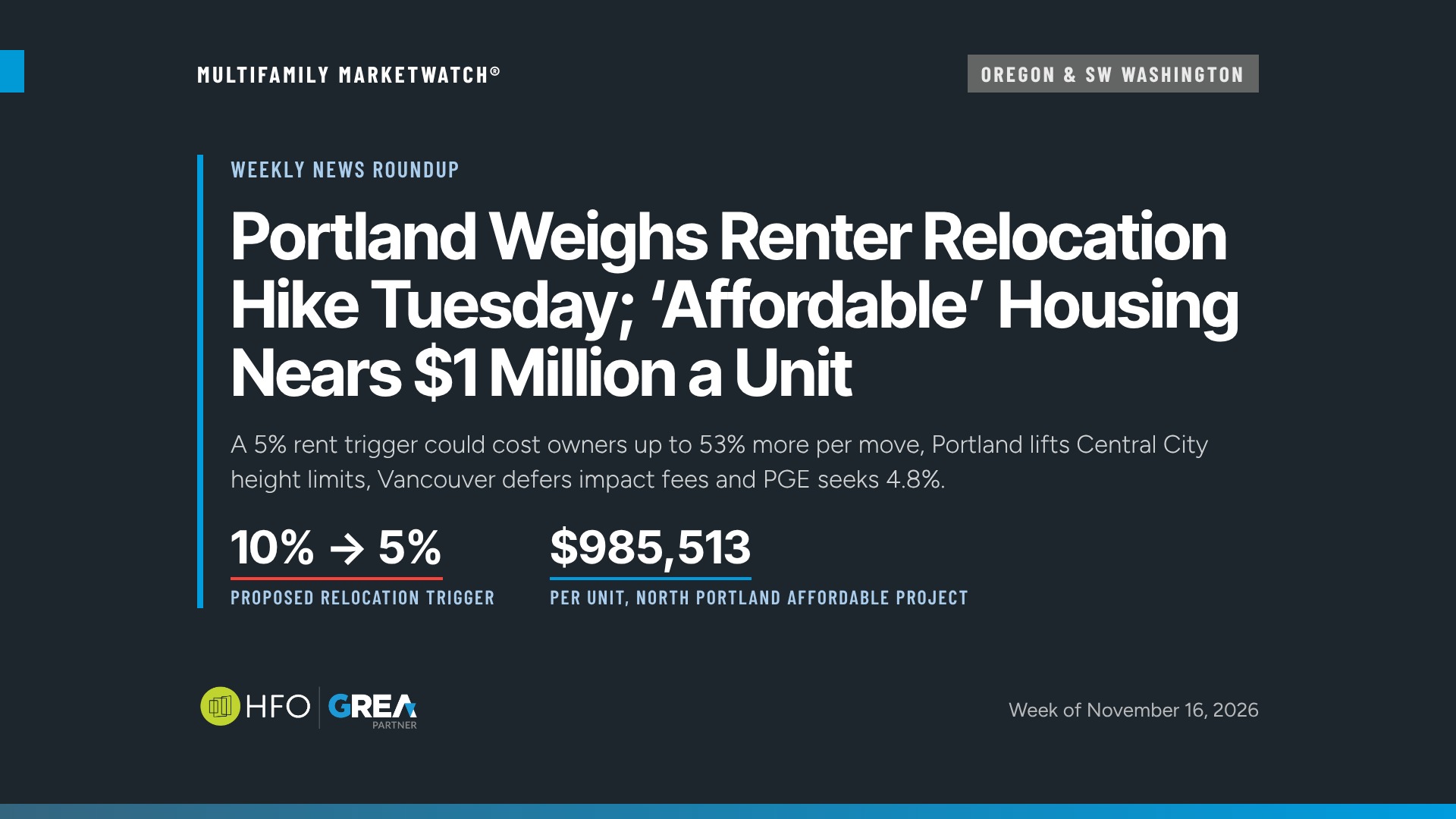
Portland’s Housing and Permitting Committee hears three renter relocation ordinances Tuesday, including one that would cut the rent increase trigger from 10% to 5% and, in the draft amounts, raise payments by as much as 53%. We lay out the details, how to testify before the 1 p.m. virtual registration cutoff and the rest of this week’s Oregon, Southwest Washington and national news.
Portland committee hears three renter relocation assistance ordinances Tuesday
Portland’s Housing and Permitting Committee will hear three ordinances on renter relocation assistance Tuesday, Nov. 17, from 2 to 5 p.m. in City Council Chambers at 1221 SW Fourth Ave. The meeting is also available online. Committee Chair Candace Avalos announced the hearing last Friday, Nov. 13, and described the city’s 2017 relocation program as applying to rent increases of 10% or more.
Ordinance 2026-418, sponsored by Councilors Mitch Green and Avalos, would lower the rent increase that triggers relocation assistance from 10% to 5%. The city’s impact statement says existing exemptions do not change.
Ordinance 2026-419, from the same sponsors, would raise the payment amounts and create a process to adjust them for inflation each year. The Daily Tidings, citing the ordinance’s Exhibit A, reports the draft amounts would rise from $2,900 to $3,837 for a studio, from $3,300 to $4,743 for a one-bedroom, from $4,200 to $6,075 for a two-bedroom and from $4,500 to $6,885 for a unit with three or more bedrooms. Those are increases of about 32%, 44%, 45% and 53%.
Ordinance 2026-420, from Councilors Tiffany Koyama Lane and Elana Pirtle-Guiney, would direct the Portland Housing Bureau to propose a relocation payment standard for tenants with school-age children.
The city’s agenda lists the three items together and says testimony on them will be heard at once. The city’s pages do not say whether the committee will vote Tuesday. We found no landlord group reaction in the coverage to date.[1],[2],[3],[4],[5],[6],[7],[8]
How to testify or file written comments
- Live testimony, in person or virtual: Sign up in advance through the city’s testimony registration form or by calling 311 (503-823-4000). Registration for virtual testimony closes one hour before the meeting starts, which puts the cutoff at 1 p.m. Tuesday. In-person testifiers must sign up before the item is heard.
- Written testimony: File it through the city’s online form, which takes a position, comments and up to three PDF, JPG or PNG files of 10 MB or less. Submissions already filed appear on the written testimony page for 2026-418. Written testimony is not accepted by email and is not read aloud at the meeting.
- Written testimony deadline: The city states no separate date or time. It says written testimony received before Council votes goes into the public record unless the agenda says otherwise. Filing before the 2 p.m. start Tuesday is the safest course.
- Each ordinance has its own page: 2026-418, 2026-419 and 2026-420. Check each page for its testimony link.
- Confirm the meeting: A strike by city professional workers began Nov. 9, and the city says some meetings may be rescheduled. The committee’s meeting page has the current status. The Council Clerk’s office can be reached at 503-823-4082.
Sources
Sources: 2026-418: Amend Portland Renter Additional Protections Code to adjust percentage rent increase triggering relocation assistance, Portland.gov, accessed Nov. 15, 2026 (free to read); 2026-419: Amend Portland Renter Additional Protections Code to adjust relocation assistance amount to align with inflation, Portland.gov, accessed Nov. 14, 2026 (free to read); 2026-420: Amend Portland Renter Additional Protections Code to add relocation assistance increase for tenants with school-age children, Portland.gov, accessed Nov. 16, 2026 (free to read); Housing and Permitting Committee Meeting,
Portland City Council Clerk, Nov. 17, 2026 meeting page (free to read); Testimony registration for 2026-418, Portland City Council Clerk, accessed Nov. 16, 2026 (free to read); Housing Chair Avalos Introduces Proposal to Strengthen Renter Protections, Office of Councilor Candace Avalos, Portland.gov, Nov. 13, 2026 (free to read); Portland Weighs Making Landlords Pay Tenants to Move After Rent Hikes of 5% or More, Daily Tidings, Nov. 16, 2026 (free to read); City services during the strike, City of Portland Bureau of Human Resources, Nov. 15, 2026 update (free to read).
Portland Council adopts Central City zoning changes, with unlimited height for residential projects
The Portland City Council passed the Central City Code Amendments Project on Thursday, Nov. 12, by a vote of 10 to 0, with two councilors absent, according to the city’s ordinance page (document 2026-343). The changes take effect March 1, 2027. The Daily Journal of Commerce reported the package amends Title 33 of the zoning code, the Comprehensive Plan Map and the zoning maps.
Two tracks raise height limits. Track 1 increases the maximum bonus height a project can earn when it also earns a floor area ratio bonus. Track 2 offers an unlimited height option for projects that meet development standards, including at least 75% residential floor area. The option does not apply in designated public view corridors, historic districts, the North Pearl and RiverPlace height opportunity areas or the South Waterfront subdistrict. The city’s ordinance summary says the unlimited height path carries a shadow analysis requirement.
Housing Prohibition Removed
The package also removes a housing prohibition in three Central Employment areas: North Russell Street, an area south and southeast of the OMSI master plan site and an area north of Southeast Powell Boulevard. It rezones a lower Albina waterfront site from industrial to mixed use and changes two Goose Hollow blocks from multi-dwelling residential to central commercial. The city also lists removal of the ground floor residential prohibition and added floor area bonuses for residential development.
Other provisions allow temporary surface parking for five years to support redevelopment, limited monthly parking in city-owned garages and food carts outside parking lots. Food cart changes apply citywide. The package also expands uses in Tom McCall Waterfront Park and reduces the river setback, and it deletes a shadow study requirement for residential areas outside the Central City and for the park.[9],[10]
Sources: Amend the Portland Zoning Code, Portland Comprehensive Plan Map and zoning maps to facilitate housing production (Central City Code Amendments Project), document 2026-343, Portland.gov, accessed Nov. 16, 2026 (free to read); Portland City Council OKs Central City code changes, Daily Journal of Commerce, Nov. 13, 2026 (gated).
Vancouver amends impact fee deferral to include middle housing
The Vancouver City Council approved a change Monday, Nov. 9, that lets developers of multifamily and middle housing defer park and traffic impact fees, The Columbian reported. Middle housing means townhouses, duplexes and cottage clusters. Payment moves from the building permit stage to the temporary certificate of occupancy. The city says that gives developers up to 23 more months, depending on construction timelines, and estimates a 100-unit project could save about $60,000 in financing costs.
City senior planner Mark Person said the city expects to receive the deferred payments within three years. The article reports no vote count, ordinance number, or effective date.
Vancouver adopted its first multifamily deferral in August 2025, effective Sept. 18, 2025. The city’s housing incentives page, last modified Sept. 8, 2026, still describes only that program, which defers fees until a developer applies for a temporary certificate of occupancy. The Columbian reports the city completed 484 multifamily units last year, down from 1,854 in 2023.[11],[12],[13],[14]
Sources: Seeking to jumpstart housing production, Vancouver will allow developers to defer impact fees, The Columbian, Nov. 10, 2026 (gated); Housing Incentives, City of Vancouver, Wash., page last modified Sept. 8, 2026 (free to read); Impact Fee Deferral (Multi-Family) Application Form, City of Vancouver, Wash., posted October 2025 (free to read); Vancouver council votes to defer park and traffic impact fees to boost multifamily housing numbers, The Columbian, Aug. 19, 2025 (gated).
PGE asks Oregon regulators for a 4.8% overall rate increase
Portland General Electric has asked the Oregon Public Utility Commission for an overall rate increase of 4.8%, effective July 2027 if approved as filed. Residential customers would see 3.9%, or about $8.33 a month for a household using 780 kilowatt-hours. PGE’s filing lists 6.3% for small businesses, 3.6% for large nonresidential customers, and 7.7% for large-load data centers.
KATU reports the commission’s final decision is due in June 2027. A virtual public comment session was held Nov. 10, and written comments are accepted through the commission’s website. The Citizens’ Utility Board says residential bills are up about 50% since 2021, OPB reported.[15],[16],[17]
Sources: The 2027 General Rate Case, Portland General Electric, accessed Nov. 16, 2026 (free to read); Public invited to comment on Portland General Electric’s proposed 4.8% rate hike, KATU, Nov. 4, 2026, updated Nov. 10, 2026 (free to read); Oregonians can comment Nov. 10 on PGE’s proposed rate increase, OPB, republished from the Oregon Capital Chronicle, Nov. 6, 2026 (free to read).
HFO closes sale of 159-unit Chesapeake Pointe in Milwaukie
HFO Investment Real Estate closed the sale of Chesapeake Pointe Apartments, 4400 SE Naef Road in the Jennings Lodge area of Milwaukie, on Nov. 4 for $23.8 million, or about $149,700 a unit. The 159-unit community was built in 1988 on 5.44 acres and has 97 one-bedroom and 62 two-bedroom units averaging 831 square feet. HFO’s Cody Hagerman and Tyler Johnson brokered the sale.
The seller was a longtime California family ownership group. The buyer was Glencrest Group, a San Francisco private investment group. Glencrest Managing Partner John Adair said the group “recognized the value of obtaining a property with major capital items already addressed.”[18]
Source: HFO Investment Real Estate Closes Sale of 159-Unit Chesapeake Pointe Apartments, Yield PRO, Nov. 13, 2026 (free to read).
State housing council adds $30 million to North Portland project now near $1 million a unit
The Oregon Housing Stability Council voted Oct. 2 to add $30 million to Monarca, a 57-unit affordable project at 1220 N. Jessup St. in North Portland, the Oregon Journalism Project reported Nov. 13. Total cost is $56.2 million, or about $985,513 a unit. The project was first funded in 2022 with a $26 million budget, about $361,000 a unit.
Work stopped in 2024 over a prevailing wage dispute. A new developer, Hacienda Community Development Corp., took over and cut the plan from 72 units to 57. Council members Ed McNamara and Javier Mena abstained. Mena said “there’s no way we would fund it” if the project were coming in today. A spokesman for the governor, Lucas Bezerra, said Oregon Housing and Community Services will examine current costs of funded projects.[19]
Source: State Housing Board Approves Low-Income Apartments That Cost Nearly $1 Million Each, Oregon Journalism Project, Nov. 13, 2026 (free to read).
Seattle developer pauses Portland-area housing development
Security Properties, a Seattle-based developer, has paused new housing development in the Portland area and cut regional staff, the Portland Business Journal reported Nov. 9, citing a difficult real estate market. [Add project names, unit counts and staffing numbers from the full PBJ story before publishing.][20]
Source: Seattle developer pauses construction projects citing tough real estate market, Portland Business Journal, Nov. 9, 2026 (gated; not read for this edition).
Lake Oswego developer asks community to invest to close a $4 million gap
Urban Development + Partners is seeking local investors to close a $4 million gap on North Anchor, a mixed-use project at B Avenue and First Street in downtown Lake Oswego, the Lake Oswego Review reported Nov. 10. The project has 67 apartments and an 86-room hotel and was split into two parts earlier this year after the sixth amendment to its development agreement. The city is contributing $750,000, $2.2 million in fee waivers and an 80% property tax abatement. The apartment completion deadline is June 2029, and the developer plans to return to the City Council in December.
Cody McNeal of Urban Development + Partners said, “There has been a general retraction of equity in the Portland metro.”[21]
Source: Developer asks community to invest in completion of Lake Oswego hotel, housing project, Lake Oswego Review, Nov. 10, 2026 (free to read).
Downtown Hillsboro’s Block 67 nears groundbreaking
The Portland Business Journal reported Nov. 10 that Block 67, a housing and retail project in downtown Hillsboro, is nearing groundbreaking. The city’s project page lists 338 units on the 3.61-acre site: 114 age-restricted units for residents 55 and older in a four-story building and 224 workforce units in a six-story building. Ground-floor retail would be anchored by a grocer, with Fresh Foods and the Hillsboro Food Co-Op having signed letters of intent. The city lists Kōz Development as developer and Deacon Construction as lead contractor, with building construction running from summer 2026 to spring 2028.
The city bought the site for $4.8 million in 2016, signed a disposition agreement with the developer in December 2024 and approved the property transfer in June 2025.[22],[23]
Sources: Downtown Hillsboro development with housing, retail nears groundbreaking, Portland Business Journal, Nov. 10, 2026 (gated; not read for this edition); Block 67, City of Hillsboro, accessed Nov. 16, 2026 (free to read).
Portland Metro Chamber survey finds record downtown commercial vacancy
A Portland Metro Chamber survey found downtown commercial vacancy at a record high and about 8,000 fewer downtown workers, KATU reported Nov. 12. Departures cited include U.S. Bank, which had more than 2,000 downtown employees, the Portland Clinic with about 500, Target and Nordstrom Rack.
KATU also reported year-over-year job losses of more than 22,000 for the Portland metro in the 12 months ending in April, which HFO was unable to verify. HFO verified that the Portland metro had 7,200 more jobs in September 2026 than in September 2025, up 0.6% not seasonally adjusted, according to the Oregon Employment Department. Seasonally adjusted, employment was down 1,600 over the same period. October data is due Nov. 24.
The survey covers office and retail space. HFO’s midyear report, released Aug. 25, put downtown Portland apartment vacancy at 7.8%, down from 8.2% in 2025 (CoStar data is available to subscribers).[24],[25]
Sources: Downtown Portland hits record vacancy; report ties 8,000-worker loss to decline, KATU, Nov. 12, 2026 (free to read); Employment and Unemployment in the Portland Metropolitan Area (September 2026), Oregon Employment Department via qualityinfo.org, Oct. 20, 2026 (free to read).
Think tank report ties Oregon’s estate tax to out-migration
A Common Sense Institute report released Nov. 11 says Oregon’s estate tax exemption of $1 million, unchanged since 2006 and not indexed to inflation, is the lowest of the 12 states with an estate tax. Rates run from 10% to 16%. Collections rose from $102 million in fiscal 2012 to $423 million in fiscal 2025. The report projects estate tax returns will rise 251% from 2023 to 2050.
The institute’s modeling puts the tax’s out-migration effect at about 125,000 fewer residents and $6.3 billion less in economic output by 2035. Those figures are modeled estimates from a nonprofit that argues for raising or indexing the threshold. Senate Bill 1511 would have raised the exclusion to $2.5 million in the 2026 session and did not pass.[26]
Source: Economic Impact of the Estate Tax in Oregon: 2026 Update, Common Sense Institute, Nov. 11, 2026 (free to read).
Lookout Eugene-Springfield series examines Lane County housing supply
Lookout Eugene-Springfield ran a five-part series, “Breaking Ground,” from Nov. 9 to 13. It reports Eugene builds about 950 units a year against roughly 1,600 needed, and that the area’s rate of 8.4 starts per 1,000 households a year is the slowest of Oregon’s five metros. The price-to-income ratio rose from 2.6 in 1990 to 6.1 in 2025.
The Lookout Editorial Board’s recommendations include adding land for housing now, cutting the 4,500-square-foot minimum lot size and raising the utility fee waiver from 60% to 80% of median income. The board also urges suspending Oregon’s prevailing wage requirement, which applies to housing projects with $750,000 or more in public funds, in cities that declare a housing crisis. It says the requirement can add 10% to 20% to costs. These are the board’s views and estimates.[27],[28]
Sources: Breaking Ground: New thinking on housing in Eugene-Springfield, Lookout Eugene-Springfield, Nov. 9 to 13, 2026 (free to read); How we dig out of our housing crisis: Lookout Editorial Board recommendations, Lookout Eugene-Springfield, Nov. 13, 2026 (free to read).
National
October inflation comes in at 0.4%, with shelter up 0.3%
The Bureau of Labor Statistics reported Nov. 10 that the consumer price index rose 0.4% in October, above the 0.3% forecast. Core prices, which exclude food and energy, rose 0.3%. The shelter index rose 0.3% after a 0.4% gain in September, with rent up 0.2% and owners’ equivalent rent up 0.3%.
BLS did not publish 12-month changes for October because it did not collect survey data for October 2025 during a lapse in appropriations. StockAnalysis, citing CME FedWatch, reports markets priced roughly an 80% or better chance of a quarter-point Fed rate hike at the Dec. 8-9 meeting. It also reports Fed Governor Waller said a 0.3% core reading could justify considering a larger increase.[29],[30],[31]
Sources: Consumer Price Index Summary, October 2026, U.S. Bureau of Labor Statistics, Nov. 18, 2026 (free to read); US consumer prices rise 0.4% in October, above forecasts, as core inflation holds at 0.3%, StockAnalysis, Nov. 10, 2026 (free to read); Consumer prices increased 0.4% in October, higher than expected, ABC7 News, Nov. 10, 2026 (free to read).
Fed holds at 3.75% to 4%, but two members wanted a hike
The Federal Reserve left its target range at 3.75% to 4% on Oct. 28 in a 10-2 vote. Lisa Cook and Beth Hammack dissented, preferring a quarter-point increase. The statement says “Inflation remains elevated.” Real Estate News reported CME FedWatch put the odds of a December quarter-point hike at 84.6% after the meeting, and quoted Realtor.com chief economist Danielle Hale saying investors expect two or three more hikes in the next six to eight months.[32],[33]
Sources: Federal Reserve issues FOMC statement, Federal Reserve Board, Oct. 28, 2026 (free to read); Divided Fed holds rates steady as investors bet on December hike, Real Estate News, Oct. 28, 2026 (carries a premium tag; full text loaded without a subscription).
NAA third-quarter report shows absorption slowing faster than completions
The National Apartment Association’s third-quarter Apartment Market Pulse reports annual absorption of about 305,000 units, down 51.3% from a year earlier, and annual completions of about 318,000, down 32.2%. Completions exceeded absorption by about 13,200 units, compared with nearly 68,500 in the second quarter. Average effective rent was $1,915, up 1.9% year over year, and occupancy was 95.4%, down 10 basis points from the second quarter.
Multifamily sales volume was $32.9 billion, up 30.8% from the second quarter and down 10.5% from a year earlier. Build-to-rent units under construction fell 18.5% to 61,208, according to the summary. NAA says the market is moving toward a healthier supply-demand balance, at different speeds in different markets.[34]
Source: The National Apartment Association releases its third-quarter Apartment Market Pulse, Building Design + Construction, Nov. 9, 2026 (free to read).
New apartment deliveries drop to their lowest level since 2019
RentCafe projects about 442,395 new apartments will open in 2026, down 27% from 605,768 in 2025. It is the first time in four years the total has fallen below the 10-year average of about 466,000, Building Design + Construction reported. The South accounts for about 47% of 2026 deliveries.
GlobeSt reported Nov. 10 that 2026 deliveries will be the lowest since 2019 and that 21 of the top 50 markets posted negative rent growth. [We did not read the full GlobeSt story; confirm both figures and the data source before publishing.][35],[36]
Sources: New apartment construction down 27% nationwide in 2026, Building Design + Construction, citing RentCafe, Nov. 12, 2026 (free to read); Apartment Deliveries Will Hit Their Lowest Level Since 2019 This Year, GlobeSt, Nov. 10, 2026 (not read for this edition).
NAHB index shows multifamily developer confidence slipping
The National Association of Home Builders’ Multifamily Production Index fell to 41 in the third quarter, down 5 points from a year earlier. Garden and low-rise stood at 46, mid-rise and high-rise at 33, subsidized at 49 and built-for-sale at 31. The Multifamily Occupancy Index fell 5 points to 69.
NAHB Multifamily Council Chairman Kip Lewis said developer sentiment “has definitely softened.” NAHB Chief Economist Robert Dietz said the group’s 2027 forecast “shows a decline for multifamily starts.” The release is dated Nov. 5, and the Mountain Democrat republished it Nov. 15.[37]
Source: Multifamily Developer Confidence Weakens in Third Quarter, National Association of Home Builders, Nov. 5, 2026 (free to read).
Trade survey data points to a more mobile, fee-sensitive renter
A Multifamily Executive year-in-review reports 43% of renters plan to move within six months, up from 38%, and 62% of those plan to move within three months. It reports 57% say junk or unexpected fees are a dealbreaker and sight-unseen leasing is up 80%. The article draws on CoStar, NAA, NMHC, SatisFacts, Entrata and other sources without attributing each figure.[38]
Source: The New Renter Reality: Trends That Have Shaped Multifamily in 2026, Multifamily Executive, Nov. 12, 2026 (free to read).
Operators told to audit utility billing and plan for 2027 increases
A Multifamily Executive Conference panel in Newport Beach, Calif., named four utility challenges: utilities are becoming a deal issue, rising costs can constrain rent growth, regulation is reshaping billing and fee transparency, and operators should get ahead of future costs by auditing rates and billing caps. Panelists included Paula Cino of the National Multifamily Housing Council and Nicole Upano of the National Apartment Association.
Joe Coleman of Decron Properties said, “If you have an inefficient building out there, you have to scale back your rent growth assumptions.” The article offers no cost figures and notes AI tools helped summarize the conference transcript.[39]
Source: 4 Utility Challenges Facing Multifamily Operators, Multifamily Executive, Nov. 10, 2026 (free to read).
Hashtags
#MultifamilyMarketwatch® #Multifamily #PortlandRealEstate #ApartmentInvesting #CRE
About HFO
HFO Investment Real Estate is the largest multifamily-only brokerage in the Pacific Northwest. The company has 12 brokers focused exclusively on apartment investment sales in Oregon and Washington. Call (503) 241-5541.
- Subscribe to HFO’s Oregon & SW Washington Weekly Newsletter for Multifamily Owners, Investors & Developers on LinkedIn.
- Subscribe to HFO’s Washington State Weekly Newsletter for Multifamily Owners, Investors & Developers on LinkedIn.
- Watch HFO’s latest YouTube interviews and subscribe.
- Click here to read more of our latest investor insights.
- Click here to see many of HFO’s current listings.