


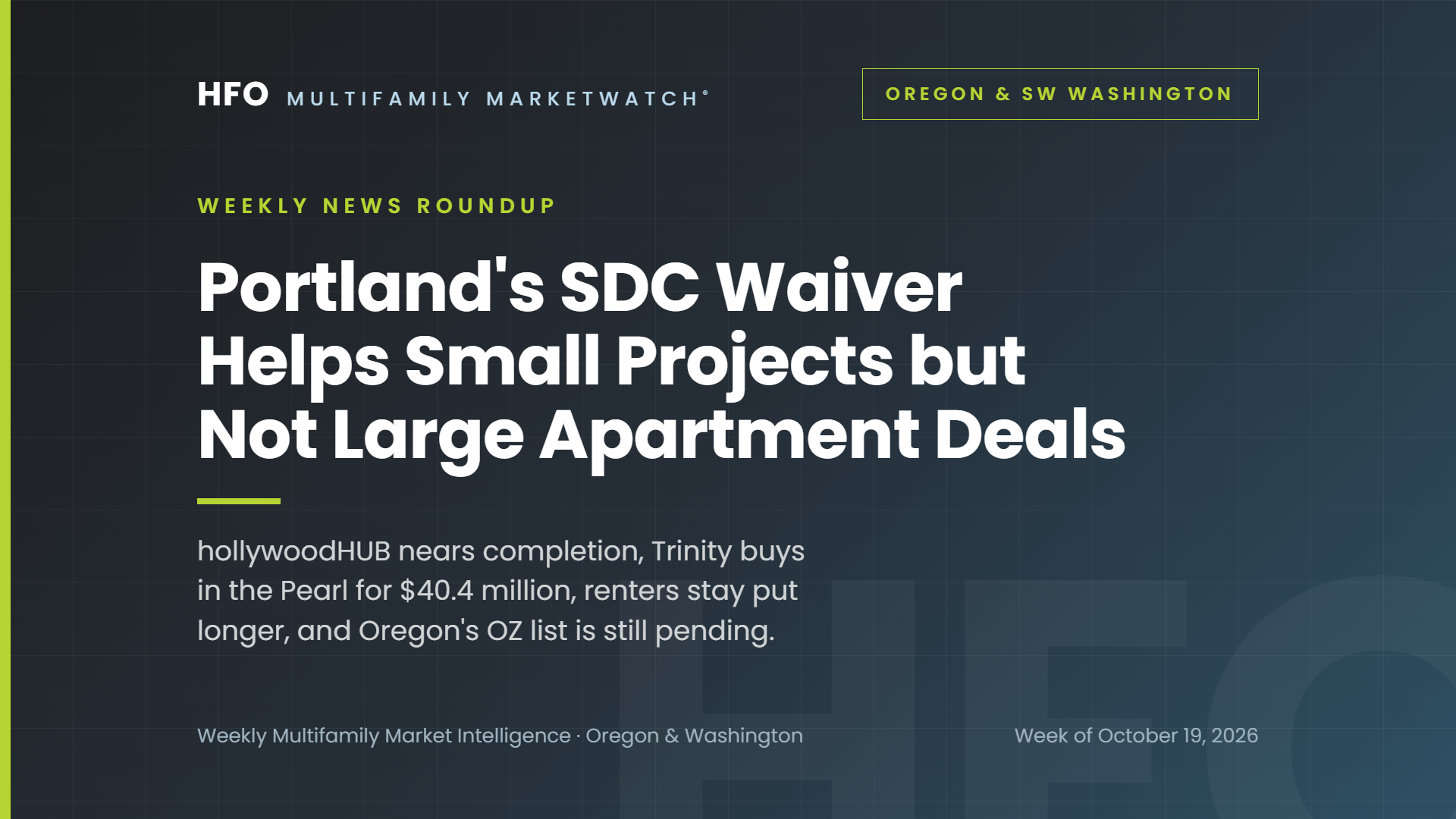
Portland’s Fee Waiver Meets Market Reality; More Renters Stay Put [10/20/26]
Oregon and SW Washington
Portland’s SDC waiver helps small projects but has not moved large apartment deals
One year into Portland’s pause on system development charges for new housing, a city report says the waiver has helped but has not been enough to restart larger apartment projects1. About 2,871 units are enrolled, 57% of the 5,000-unit goal, but most are in projects under 20 units, and only five projects with 50 or more units have enrolled. The city issued permits for 1,072 units through Aug. 14, on pace to match or slightly exceed 2025’s total of about 1,370. SDCs average about $20,000 per unit, and the waiver runs through Sept. 30, 20282. If the city permits all enrolled units, it would forgo roughly $51 million in revenue.
Why it matters: Policy intent versus market reality: a fee waiver cannot offset high construction costs, interest rates, and thin institutional financing for large projects. That keeps the new supply pipeline light, which supports occupancy and rents for existing Portland owners over the next two to three years.
hollywoodHUB nears completion with 224 affordable units at the Hollywood Transit Center
Construction is nearly complete on hollywoodHUB, a 12-story, 224-unit affordable tower by BRIDGE Housing at 4110 NE Halsey St. in Northeast Portland, on a former TriMet bus turnaround3. The building includes 71 units for households at 30% of area median income and 151 at 60% AMI, plus two manager units; 125 units have two or three bedrooms. Completion is expected in spring 2027.
Why it matters: This is one of the largest family-size affordable additions in Northeast Portland. Owners of nearby older apartments that serve income-qualified renters should expect some lease-up competition next spring.
Trinity Property Consultants pays $40.4 million for Pearl District’s 10th @ Hoyt
An affiliate of Irvine, Calif.-based Trinity Property Consultants paid $40.4 million, about $226,966 per unit, for the 178-unit 10th @ Hoyt apartments in Portland’s Pearl District4. Trinity also bought a 31-building complex in Kent, Wash., for $72 million earlier this month5.
Why it matters: A national operator buying in both Portland’s urban core and suburban Puget Sound within weeks is an early sign that institutional capital is continuing its return to Northwest apartments at today’s pricing. The deal gives Pearl District owners a fresh per-unit comp.
Oregon renters are staying put longer
Oregon’s renter mobility rate fell from about 31% in 2014 to 22.5% in 2024, based on Census data compiled by TurboTenant6. Nationally, renewals now make up 57% of apartment leasing activity, up from 51% in 2015, according to CBRE. With 49.9% of U.S. mortgages at 4% or lower, fewer owners sell and fewer renters move up to buy.
Why it matters: Lower turnover cuts make-ready and marketing costs and steadies occupancy. It also means more of an owner’s revenue growth will come from renewals, so renewal pricing and resident retention matter more than ever.
Oregon’s Opportunity Zone list still pending ahead of Oct. 28 deadline
Gov. Tina Kotek requested and received a 30-day federal extension, moving Oregon’s deadline to submit Opportunity Zone 2.0 nominations to Oct. 28, 20267. As of Oct. 19, we found no public list. Oregon can nominate up to 58 of its 229 eligible tracts8. New zones take effect Jan. 1, 2027.
Why it matters: Oregon’s list should arrive within nine days. Investors and developers with Portland-area sites should watch for it, since inclusion could change a project’s after-tax math for the next 10 years.
National and Federal Signs
Insurance relief is uneven as underwriting gets stricter
Multifamily insurance premiums have risen 75% since 2019, and a Federal Reserve study found that each $1 increase in insurance cuts owner net income by $0.7210. Premiums eased over the past year as capacity returned, but carriers are raising deductibles, lowering limits, and adding exclusions for older roofs and electrical systems. Wildfire-exposed areas now include parts of the Pacific Northwest, and hardening measures can cut insurance costs by 30% to 50%.
Why it matters: Two similar buildings can now get very different quotes based on documentation and condition. Owners should build complete renewal packages, including roof age, maintenance logs, and loss history, and compare total cost of risk, not just premium.
Inflation rises to 3.7% in September
The Consumer Price Index rose 3.7% from a year earlier in September, driven mainly by fuel prices, according to data released Oct. 1411. Core inflation, which excludes food and energy, rose to 2.6% from 2.4% in August. Real average hourly earnings fell 0.7% over the past year.
Why it matters: Hotter inflation reduces the odds of rate relief and keeps pressure on long-term borrowing costs. Falling real wages also limit how much renters can absorb at renewal.
FHA opens multifamily loan programs to build-to-rent communities
HUD made build-to-rent communities of single-family homes, duplexes, and triplexes eligible for FHA-insured financing under its Section 221(d)(4) new construction and Section 223(f) acquisition and refinance programs, effective immediately12. Projects must sit on a single site and operate as one property, and mixed projects with apartment buildings are allowed.
Why it matters: Long-term, fixed-rate HUD debt for build-to-rent opens a new financing path for developers, including on suburban sites in Clark County and the Willamette Valley. Expect more horizontal rental product to compete with garden apartments over time.
Family succession: planning for the ‘cousin problem’
A Wall Street Journal essay by Harvard Business School faculty member Christina Wing describes how family assets often run into conflict when ownership passes to the third generation, when cousins become co-owners13. She recommends building relationships before transferring assets, planning for uneven contributions with tools such as a trustee-held share, and talking openly about heirs’ different financial needs.
Why it matters: Many Northwest apartment buildings are family-held, and generational transfers are a common reason properties come to market. Owners who plan succession early can avoid forced sales and keep control over timing.
Sources
- Portland Business Journal, “Portland SDC waiver not enough to spur large-scale housing development, report says,” Oct. 13, 2026. (available to subscribers)
- OPB, “Portland fee waiver program hasn’t spurred massive increase in new construction,” Oct. 19, 2026.
- Next Portland, “Under Construction: hollywoodHUB (images),” Oct. 5, 2026. Link goes to the Next Portland home page; the article URL was truncated in the uploaded copy.
- Commercial Real Estate Direct, citing the Portland Business Journal, “Portland, Ore., Apartment Property Fetches $40.4Mln,” Oct. 16, 2026.
- The Real Deal, “Rise Properties sells another apartment complex amid Seattle-area selloff,” Oct. 6, 2026.
- TurboTenant via Stacker (Fox 26 Medford), “Renters in Oregon aren’t moving. Here’s what the data shows.,” Oct. 12, 2026.
- Business Oregon, “Opportunity Zones program page,” accessed Oct. 19, 2026.
- OpportunityZones.com, “OZ 2.0 State Tracker,” accessed Oct. 19, 2026.
- HFO Research via Rental Housing Journal, “Clark County Rents Hold Their Ground Against Portland,” Oct. 13, 2026. CoStar data cited is available to subscribers.
- Multi-Housing News, “Managing Insurance Costs as Climate Risk Rises,” Oct. 14, 2026.
- Yahoo Finance, “CPI: Prices rose 3.7% in September,” Oct. 14, 2026.
- Multifamily Dive, “Build-to-rent now eligible for Federal Housing Administration financing,” Oct. 16, 2026.
- The Wall Street Journal (essay), “Who Gets the Bulk of Grandma’s Estate? Here’s How to Solve the ‘Cousin Problem’,” Oct. 16, 2026. (available to subscribers)
About HFO
HFO Investment Real Estate is the largest multifamily-only brokerage in the Pacific Northwest. The company has 12 brokers focused exclusively on apartment investment sales in Oregon and Washington. Call (503) 241-5541.
- Subscribe to HFO’s Oregon & SW Washington Weekly Newsletter for Multifamily Owners, Investors & Developers on LinkedIn.
- Subscribe to HFO’s Washington State Weekly Newsletter for Multifamily Owners, Investors & Developers on LinkedIn.
- Watch HFO’s latest YouTube interviews and subscribe.
- Click here to read more of our latest investor insights.
- Click here to see many of HFO’s current listings.