


Washington’s Rent Cap Lawsuit
Washington State
Court hears constitutional challenge to Washington’s rent cap
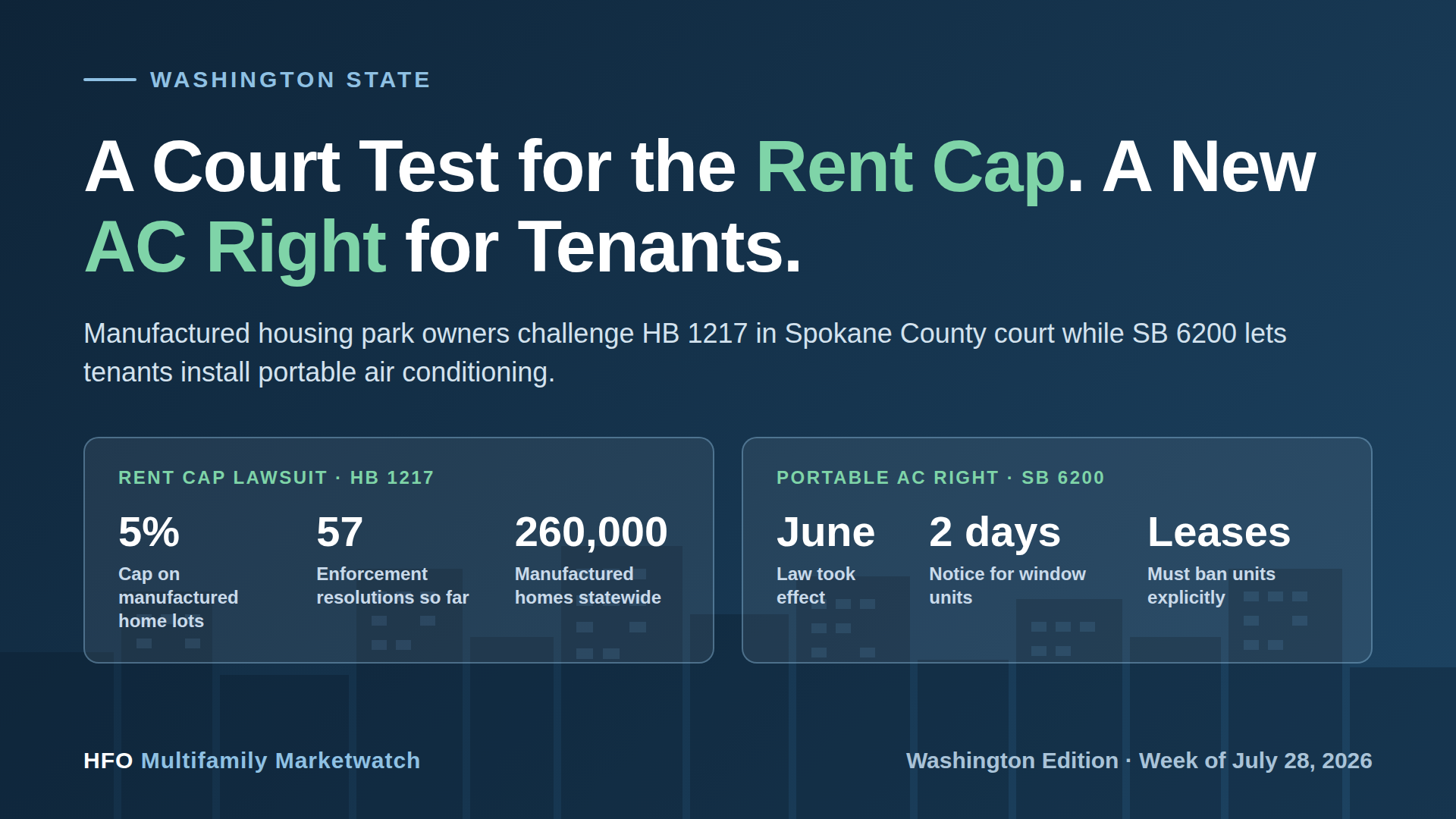
Spokane County Superior Court heard arguments July 22 in a lawsuit by manufactured housing park owners challenging Washington’s rent stabilization law, House Bill 1217. The law caps increases at 7% plus inflation up to 10% for most rentals but just 5% for manufactured home lots. Plaintiffs argue the cap is unconstitutional and lacks hardship exemptions. The attorney general’s office says it has already entered 57 court-filed resolutions with landlords over alleged violations. About 260,000 manufactured homes make up 8% of the state’s housing stock.
Why it matters: The case is the most direct legal test of HB 1217 so far. A ruling on the 5% manufactured housing cap could shape challenges to the broader law. Owners in Washington should keep documenting compliance, since enforcement is clearly active.
New Washington law makes portable air conditioning a tenant right
Senate Bill 6200, effective in June, gives Washington tenants the right to install portable air conditioning units unless a lease explicitly bans them. Window units come with conditions, including two days’ notice, secure installation, window locks that still function and insurance compatibility. Landlords can still deny units where a building lacks electrical capacity or an installation causes damage.
Why it matters: Expect more tenant-installed units this summer. Owners should check panel and circuit capacity, update lease language and set an inspection routine now rather than after a failure.
Washington energy code changes open for comment through Aug. 7
The State Building Code Council is taking public comment on updates to the 2024 residential and commercial energy codes until 11:50 p.m. Aug. 7, with a public hearing the same day from 10 a.m. to 5 p.m. in Spokane. The Building Industry Association of Washington supports adding an energy rating index pathway but says the draft still discourages gas use and adds construction cost without meaningful savings.
Why it matters: Energy code decisions flow straight into development budgets. Developers and owners planning Washington projects have until Aug. 7 to get concerns on the record.
Tri-Cities apartment pipeline grows to about 1,800 units
About a dozen developers have roughly 1,800 units in development or planning across the Tri-Cities, supported by nearly 6,000 jobs added in 12 months. Spring vacancy stood at 7.9%, with asking rents averaging $1,700 at high-end properties, $1,424 at mid-level and $1,228 at older ones, per a CoStar report published by The Management Group (CoStar data is available to subscribers). Active projects include the 195-unit Havenridge and 72-unit Badger Heights in Kennewick and the 192-unit Bob, 144-unit Innovation Center and 264-unit Copper View in and around Richland. The average home price of $485,000 requires about $150,000 in household income, while the average local job pays about $73,500.
Why it matters: The homeownership gap is doing the demand work in the Tri-Cities. But 1,800 units against a 7.9% vacancy rate deserves attention. Job growth needs to keep pace for that pipeline to lease well.
Tech layoffs weigh on Seattle housing, D.R. Horton says
D.R. Horton’s CEO told analysts the builder sees weakness in the Northwest, especially Seattle, tied to software job losses. Amazon announced 2,100 local layoffs in January and Meta cut nearly 1,900 area positions this year. Seattle’s median home price fell 2.3% year over year as of May, per Redfin, against a 2% national gain, and area unemployment touched a five-year high in January.
Why it matters: Soft home sales usually help rentals, but layoffs cut household formation too. Seattle owners should watch tech employment more closely than for-sale inventory this year.
Oregon
Portland proposes carbon reporting and reduction plans for buildings of 20,000 square feet or more
Portland’s proposed Climate and Health Standards for Existing Buildings, led by District 1 Councilor Candace Avalos, would require all commercial and multifamily buildings of at least 20,000 square feet to report annual energy performance to the city by June 1 each year. The city would use that baseline to set targets cutting each building’s emissions 20% every five years until reaching zero by 2050. The current program covers about 1,000 buildings and excludes residential properties. The Portland Metro Chamber and other groups have asked how building age and occupancy will factor into targets and what funding will help owners comply. The Housing and Permitting Committee votes Sept. 1 on whether to advance the draft to the City Council.
Why it matters: This is the first Portland climate policy that reaches deep into the apartment stock, and Washington owners should watch it too. Seattle already has a building emissions performance standard, and city-level carbon rules tend to spread. Owners of larger buildings on both sides of the river should expect benchmarking first and capital planning for mechanical and envelope upgrades later.
National
Builders brace for a slower year as tech job cuts mount
Tech companies announced almost 124,000 job cuts nationally through the beginning of June, up more than 65% from a year earlier, as firms shift spending toward artificial intelligence. D.R. Horton, the country’s largest homebuilder, expects to sell fewer homes this year than previously forecast and says buyers need more confidence in the economy before committing, with higher mortgage rates and inflation still weighing on the market.
Why it matters: Every buyer who stays on the sidelines is a renter a little longer, which supports apartment demand. The caution flag is where the layoffs land. Tech-heavy metros like Seattle get the demand risk along with the rental tailwind.
#MultifamilyMarketwatch® #Multifamily #WashingtonRealEstate #ApartmentInvesting #CRE
HFO Investment Real Estate is the largest multifamily-only brokerage in the Pacific Northwest, with 12 brokers focused exclusively on apartment investment sales in Oregon and Washington. Call (503) 241-5541
- Subscribe to HFO’s Oregon & SW Washington Weekly Newsletter for Multifamily Owners, Investors & Developers on LinkedIn.
- Subscribe to HFO’s Washington State Weekly Newsletter for Multifamily Owners, Investors & Developers on LinkedIn.
- Watch HFO’s latest YouTube interviews and subscribe.
- Click here to read more of our latest investor insights.
- Click here to see many of HFO’s current listings.