


![Portland’s Proposed Vacancy Tax Survey Results: Would Drive Investment Out, Not Fill Units – [5/1/26]](https://www.hfore.com/wp-content/uploads/2026/05/vacancy-tax-idea-image.png)
Portland’s Proposed Vacancy Tax Survey Results: Would Drive Investment Out, Not Fill Units – [5/1/26]
Portland’s Proposed Vacancy Tax Survey — Multifamily Reading
A Portland State University Center for Real Estate survey, fielded April 16–24, 2026, asked 415 commercial real estate professionals — owners, developers, brokers, and property/asset managers, each with at least 1% of their portfolio in the City of Portland — to weigh in on the City’s exploration of a vacancy tax. The headline finding for multifamily is straightforward: respondents say the tax would not change how they lease, but it would change whether they keep investing in Portland at all.

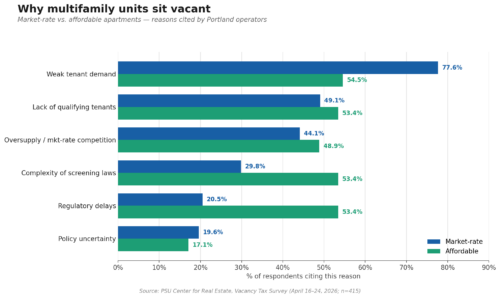
Both market-rate and affordable housing segments name weak tenant demand as the top driver, but the secondary reasons diverge sharply — and that divergence matters for any municipal, county, or state government policy response.
- Market-rate apartments (top reasons): Weak tenant demand 77.64%; lack of qualifying tenants 49.07%; oversupply in submarket 44.10%; complexity of screening laws 29.81%; regulatory delays 20.50%; policy uncertainty 19.57%.
- Affordable apartments (top reasons): Weak tenant demand 54.55%; complexity of screening laws 53.41%; regulatory delays 53.41%; lack of qualifying tenants 53.41%; competition from market-rate buildings 48.86%.
- Speculative motives are essentially absent. Among market-rate operators, only 2.48% cite “waiting for higher rents” and 0.62% cite “tax benefits from losses.”
- Open-ended comments tied weak demand to safety concerns, homelessness and crime, nearby abandoned properties, fewer jobs, high taxes, residents leaving the area, and a perceived decline in Portland’s quality of life.
- Affordable operators added Home Forward referral delays, dried-up rental assistance, excessive move-out damage, repair backlogs from labor shortages, and PSH lease-up timelines as material contributors.

Market-rate and affordable operators report nearly identical playbooks for filling units:- Other tactics named in open responses: accepting more rent-assistance residents, adding amenities (AC, remodeled kitchens, dog acceptance), increasing on-site staffing, lowering security deposits, paying for private security, referral credits, beautification, and lowering income/credit requirements.
- Affordable operators flag a constraint: LIHTC and other public funding rules cap their leasing flexibility — they do not have the same dial to turn as market-rate operators do.
Why it matters
The survey punctures the central assumption behind a vacancy tax: that landlords are sitting on empty units by choice. Less than 1.2% report any intentional vacancy, and the few who do are doing so for staff space, renovations, or pending owner-occupier sales — situations that a tax cannot redirect to the rental market. The actual drivers of vacancy in Portland multifamily are demand-side and regulatory: weak tenant demand tied to public-safety perception, qualifying-income gaps, screening-law complexity, and Home Forward processing delays for affordable units. A tax on vacancy taxes the symptom, not the cause.
Intentional vacancy is statistically negligible
- 98.82% of respondents do not hold units vacant intentionally — a near-unanimous finding directly relevant to the policy theory of a vacancy tax.
- The 1.18% who do report intentional vacancy cite four reasons: staff use (e.g., on-site bathroom or break space), refurbishment, planned sale to an owner-occupier, and functional obsolescence — none of which a vacancy tax meaningfully addresses.

Leasing behavior would barely move:
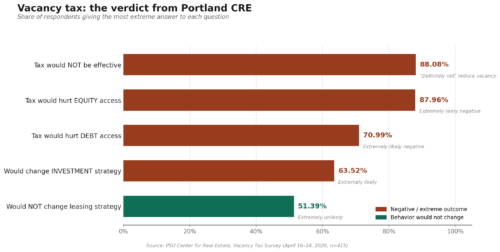
- 51.39% say it’s extremely unlikely to change their leasing strategy; another 17.99% say somewhat unlikely. Combined “unlikely” share: 69.38%.
- Affordable providers specifically note their leasing flexibility is already constrained by regulation — the tax would deepen financial distress without altering behavior.
- A few respondents listed strategies they would adopt under duress: passing the tax through as higher rent, reducing renting standards, defaulting on the mortgage and handing the asset back to the bank, converting to a condo, or even filing a lawsuit.
Investment and development behavior would shift sharply:
- 63.52% say a vacancy tax is extremely likely to change investment and development strategy.
- The two most common stated responses are: sell properties and exit Portland; and abstain from new investment and development in the city.
- Other named consequences: tougher underwriting (factoring the tax into lease length and tenant strength), lower valuations, demolition of upside-down buildings, increased reluctance among out-of-market investors, and nonprofits declining donated properties for fear of carrying costs.
Capital access would tighten dramatically:
- 87.96% say the tax is extremely likely to negatively affect equity access; another 8.53% say it is somewhat likely.
- 70.99% say the tax is extremely likely to hurt debt financing; another 23.30% say somewhat likely.
And on whether it would actually work:
- 88.08% say the tax is definitely not effective in reducing vacancies; another 5.96% say it is probably not. Combined skeptical share: 94.04%.
- Only 1.76% support it (probably yes plus definitely yes), and the four supportive open-ended explanations were divided — one drew an analogy to Pennsylvania’s land-tax experiment, one argued the tax could force ownership turnover that unlocks reuse, and one explicitly distinguished multifamily (where they saw a case) from retail (where they didn’t).
Bottom line for multifamily
The survey reads less as feedback on a policy proposal and more as a near-consensus warning. Operators say they are not intentionally holding units vacant, the tax would not meaningfully change leasing behavior, and it would actively change investment behavior — toward selling and exiting — while damaging access to both equity and debt. Nearly nine in ten respondents say it would not even succeed at its stated objective. For a city already facing last-place metro employment growth among the top 54 U.S. metros and a persistent cap-rate discount relative to national averages, the survey suggests a vacancy tax would compound, not alleviate, Portland’s investment headwinds.
What respondents say would actually help
The 415 respondents redirected the policy conversation toward seven alternative themes:
- Be a partner. Bring CRE owners, managers, and tenants to the table. Improve city staff understanding of how the city and the CRE industry depend on each other.
- Improve Portland’s appeal. Pursue economic development to attract employers, address public safety and street conditions, and rework the tax structure to make the city competitive with peer metros.
- Repair the city’s perception. Run a positive Portland PR campaign, create a business-friendly environment, and lead by example by bringing City employees back to the office.
- Fix permitting and regulation. Streamline repurpose/remodel permitting, reduce red tape and fees, reconsider rent caps, inclusionary zoning, the ground-floor retail mandate, and the FAIR ordinance, and improve law-enforcement responsiveness.
- Innovative funding. Establish revolving loan funds, matching grants, property-tax relief, or rental-registration relief tied to occupancy thresholds (e.g., 85–90%), tax rebates for high-occupancy buildings, and free legal support for landlords.
- Improve the operating environment for affordable housing. Accelerate Home Forward processes, build more dependable rent-assistance programs, provide transitional support for unhoused tenants moving into voucher units, allow higher deposits to offset risk, and offer guarantees to owners renting to tenants with weaker credit.
- Address workforce shortages. Help close the trades gap and support training of on-site affordable-housing staff.
Voices from the field
Jim Mark, CEO of Melvin Mark Cos. — which manages roughly 4 million square feet of Portland commercial space — told the Portland Business Journal in March that owners are doing everything they can to fill space, including, in his case, “basically giving away” 20,000 square feet. Julie Freybote, the PSU professor who compiled the survey, framed the findings as a starting point for the City and the industry to work together rather than across the table from each other, noting that owners and the City ultimately want the same outcome: as little vacancy as possible in a thriving city.
The City Council has commissioned ECOnorthwest and Field States to study a long-term vacancy fee structure for commercial and residential spaces. The initial findings were expected by April 30. Accordingly, Freybote has shared the survey results with both research teams, and the results will be incorporated into the report to the City.