


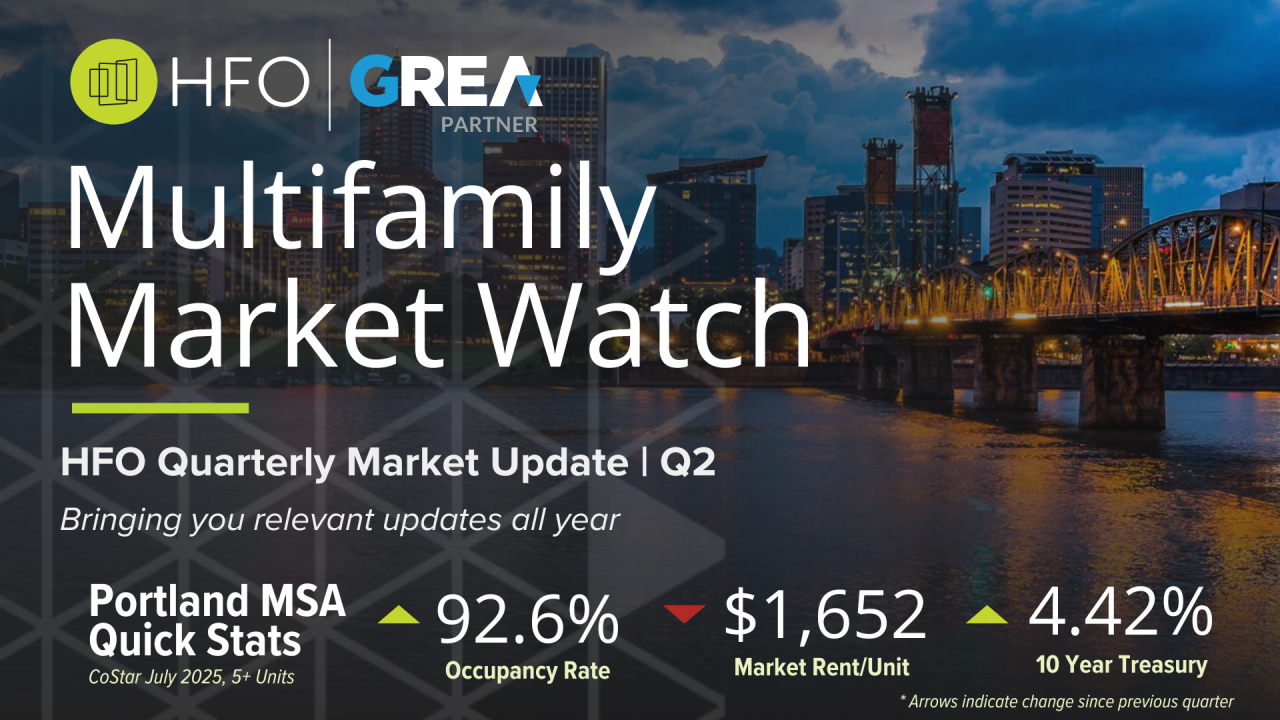
Portland Multifamily Market Report Q2 2025: Stabilizing Fundamentals, Suburban Strength, and a Pipeline Slowdown
Following several quarters of economic turbulence, persistent inflation, and elevated interest rates, Portland’s multifamily market is beginning to show signs of stabilization. Here’s our Q2 2025 Portland multifamily market report: the region experienced a boost in net absorption, a decline in vacancy rates, and a significant slowdown in new deliveries, laying the groundwork for a more balanced and potentially optimistic second half of the year.
Here’s a breakdown of the most important trends from Q2 2025—and what they mean for multifamily stakeholders across Oregon and Southwest Washington.
Bonus Download: HFO Multifamily Marketwatch Report Q2 2025
Absorption Surge Eases Vacancy Pressure
The Portland metro absorbed 1,400 units in Q2 2025, outpacing the historical quarterly average of 810 units and bringing 12-month net absorption to 5,138 units—a dramatic leap from the 1,700-unit low in Q2 2023. This uptick in demand helped push the market-wide vacancy rate down to 7.5%, a welcome shift from the post-pandemic highs that plagued 2023 and the early part of 2024.
Submarkets driving this rebound include Vancouver, Clark County, and Clackamas County, where renters continue to relocate for affordability, proximity to employment hubs, and tax advantages. Notably, Vancouver saw a vacancy drop of more than 100 basis points year-over-year, cementing its status as the metro’s largest, most resilient, and most active submarket.
Class segmentation remains stark:
- Luxury (4- and 5-star) units have a vacancy rate of 9.6%, burdened by a glut of recent deliveries.
- 3-star properties exhibit more stable performance with a 6.9% vacancy rate.
- 1 & 2 Star assets remain the tightest with 5.7%, reinforcing demand in the workforce housing tier.
Rent Growth Flat—But Poised to Rebound
Asking rents across the metro are holding steady at $1,680/month, with year-over-year growth clocking in at a tepid 0.1%—a figure well below Portland’s 10-year historical average of 3.1%.
While growth is slow, there’s nuance worth noting:
- 3 Star units saw modest gains of 0.3% YoY, with 1 & 2 Star units up 1.2%, reflecting the resilience of price-sensitive renters.
- Meanwhile, 4- and 5-star properties posted negative rent growth at -0.53%, pressured by competition and entrenched concessions, with many offering 2–3 months of free rent.
Despite flatlining, the fundamentals are improving. CoStar’s base case projects rent growth approaching 2% by year-end, assuming continued demand and limited new supply. The tightest rent growth trajectories remain in suburban and exurban submarkets, such as Outlying Washington County, Yamhill County, and Clark County, where asking rents often remain under $1,500 per month.
Bonus Download: HFO Multifamily Marketwatch Report Q2 2025
Construction Activity Falls Off a Cliff
The development slowdown is real and dramatic. Only 3,000 units remain under construction, compared to the 13,000-unit peak in late 2022. This represents a 77% decline in pipeline volume over the past three years. With sub-500-unit groundbreakings in three of the past four quarters, 2025 is shaping up to be the weakest year for new deliveries since 2011.
Q2 2025 saw no notable groundbreakings, and the number of units expected to be delivered in the second half of the year is limited. That’s a major shift from 2024, which saw 8,891 units in assets of 5+ units, and it’s setting up an undersupplied market by late 2026 if demand holds steady.
Where activity persists, it’s focused on:
- Southwest Portland: South Waterfront remains a hotspot, with Alamo Manhattan’s five-building project set to add over 600 units. The neighborhood benefits from its proximity to OHSU, which is wrapping up a $610 million expansion that will generate 3,000 new jobs upon completion in 2026.
- Vancouver, WA: With around 1,600 units delivered in the past 12 months and 629 more under construction, Vancouver is outpacing all other Portland metro submarkets thanks to faster permitting and friendlier zoning.
Sales Activity Rebounding—Cap Rates Leveling Out
After two bruising years, the Portland investment market is showing signs of life. Transaction volume hit $1.0 billion in 2024, a 62% jump YOY, and 2025 is off to a solid start. The first half of 2025 has already seen nearly $760 million in deals, representing a 50% increase from the same period in 2024.
Pricing, however, is still adjusting:
- The average price per unit in 2024 was $243,803, with a market-wide average cap rate of 5.5%. The YTD 2025 average price per unit is $245,535.
- Cap rates ranged from 5.0% to 6.5%, depending on location and asset quality. 4- and 5-star assets drew institutional interest in the urban core, while private buyers targeted 3-star opportunities in fringe and suburban submarkets.
Notable sales include:
- Peloton Apartments (265 units, built 2016) in North Portland sold for $88 million ($332,075/unit) in June.
- Ansley Murray Hill in Beaverton (304 units, built in 1985) sold for $76.7 million ($252,302 per unit), underscoring suburban investor confidence.
- HFO-represented sale Avana Powell Valley in Gresthem (228 units) traded in January for $45.95 million.
Bonus Download: HFO Multifamily Marketwatch Report Q2 2025
Submarkets: A Tale of Two Markets
Multnomah County and the City of Portland continue to struggle. Older buildings with seismic issues, smaller unit sizes, and local tax burdens have seen valuations drop over 30% from peak levels. Urban core vacancy remains elevated, especially in the Northwest and Downtown submarkets.
In contrast, suburbs and tertiary markets are outperforming:
- Hillsboro, Tigard, and Beaverton are effectively absorbing new supply.
- Clark County leads in both absorption and rent growth.
- Yamhill County is seeing strong lease-up activity with limited upcoming supply.
Investors are responding in kind. Capital—especially from California and out-of-state buyers—is increasingly targeting suburban assets where pricing remains attractive and fundamentals are stronger.
Regulatory Snapshot
- Oregon’s statewide 10% rent cap was matched this year by Washington State.
- Meanwhile, the Portland City Council has postponed a ban on algorithmic rent pricing for the time being.
Pro-Development Activity – Oregon and Portland
On the upside, those same state and local leaders, including those in Portland, have signaled interest in streamlining development, with a particular focus on fast-tracking multifamily and mixed-use projects. The City Council has:
- Adopted a System Development Charges waiver. The waiver will last for 3 years or 5,000 units, whichever comes first.
- Reduced bicycle parking requirements
- Adopted active-use rule waivers for ground floors
- Streamlined various loading, ecoroof, design-overlay, and master-plan standards
- Rebooted a self-certification program for code compliance by licensed professionals
- Approved $15 million for funding middle-income office-to-housing conversions downtown
Outlook: A Market Reset, Not a Recession
As we close out Q2 2025, the Portland metro multifamily market appears to have weathered the worst of its correction.
- Vacancy is trending down
- Rents are holding firm or inching upward
- Deliveries are slowing
- Sales are picking up steam
Is this a recovery? Not quite—but it’s a clear reset.
For multifamily owners, investors, and developers, the smart play right now is strategic patience and submarket selection. Suburban product, particularly well-located 3-star and newer 1- and 2-star assets, is showing stable performance and moderate rent growth. Urban luxury may take longer to rebound, especially as concessions remain sticky.
The next 6–12 months will clarify whether this stabilization becomes a true recovery or a pivot toward a permanently more decentralized multifamily landscape.
Report based on CoStar Market Analytics – Portland Multifamily Market Report, July 10, 2025. Additional analysis provided by HFO Investment Real Estate.
Bonus Download: HFO Multifamily Marketwatch Report Q2 2025
Watch HFO’s latest YouTube interviews and subscribe.