


Will Washington Gov’t Pay? COVID Takings Lawsuit Update [11/3/26]
Washington Landlords’ Eviction Moratorium Takings Case Heads to Ninth Circuit
By Aaron Kirk Douglas, Director of Market Intelligence, HFO Research
Grocery stores were never ordered to give away food during the pandemic. Gas stations were not told to pump for free, and utilities kept billing for power. Rental housing providers were the exception. For more than a year, state and local eviction moratoriums barred them from removing residents who stopped paying rent.
Whether that amounted to a government taking of private property is the question at the center of Cedarland Homes v. Ferguson, a class action on behalf of Washington landlords. John A. DiLorenzo Jr., a partner at Davis Wright Tremaine and lead counsel in the case, laid out where it stands in an interview with HFO Investment Real Estate partner Greg Frick for HFO’s Multifamily Marketwatch video series.
The legal theory is simple.
The Fifth Amendment allows the government to take private property for a public purpose, but it must pay for it. DiLorenzo argues the moratoriums took the one right that matters most to a landlord who has leased a unit: the right to exclude someone who no longer belongs there. “If you are not entitled to be able to require the collection of rent, they have all the assets, and you just have the liabilities,” he said.
Oregon owners have largely moved past the issue. After DiLorenzo filed Farhoud v. Brown, U.S. District Judge Michael Simon ruled the Oregon moratorium was not a per se taking, though he observed it likely impaired landlords’ contracts. The case may have prompted a legislative deal that paid owners 80 percent of forgiven rent in exchange for writing off the other 20 percent. In the following session, the state covered the remaining 20 percent, with then House Minority Leader Christine Drazan pressing the issue.
Washington got no such fix. The legislature passed a bill that would have funded compensation, but Gov. Jay Inslee vetoed it. A limited state program capped payments at $15,000 per claim.
Working with Nonprofits and Associations on a Plan
So DiLorenzo’s team worked with the Rental Housing Association of Washington and the Pacific Legal Foundation to build a test case. They interviewed more than 70 landlords and selected 15 whose losses were significant and who operated in jurisdictions with their own moratoriums, including Seattle, King County, Spokane, Everett, Kirkland, Kenmore, Burien, and Olympia. The suit was filed in Thurston County Superior Court in December 2025 to avoid the immunity states enjoy from damage claims in federal court. The defendants removed the case to federal court anyway, which DiLorenzo said waived that immunity.
As expected, U.S. District Judge Barbara Rothstein dismissed the case in August. She was bound by the Ninth Circuit’s 2024 decision in GHP Management v. City of Los Angeles, which held that pandemic eviction limits were not physical takings, and by the Washington Supreme Court’s 2023 ruling in Gonzales v. Inslee. The plaintiffs appealed immediately. Briefs were filed in October, and DiLorenzo expects oral argument in early 2027.
The dismissal is part of the plan.
The real target is a split among the federal appeals courts. The Eighth Circuit, in Heights Apartments v. Walz, found Minnesota’s moratorium was a taking. The Federal Circuit, which hears claims against the U.S. government, reached the same conclusion about the CDC’s national moratorium in Darby Development v. United States. The Ninth Circuit went the other way. The Supreme Court exists in part to settle exactly that kind of disagreement.
The court has declined earlier petitions on the issue, but Justice Clarence Thomas has written to explain why, DiLorenzo said. Some cases sought only injunctions after the moratoriums had ended. Others sued states for damages in federal court, where immunity applies. Cedarland was built to clear each of those hurdles. “This is the case that has resolved all of the other objections that there were to the other cases,” DiLorenzo said.
Darby could add pressure. The federal government chose not to seek Supreme Court review, and the plaintiffs’ lawyers have added thousands of landlords to a complaint that now runs about 500 pages. If the government pays owners in the middle of the country, DiLorenzo said, the Supreme Court should consider why West Coast owners under nearly identical orders should be treated differently.
Timing matters.
California’s short statute of limitations may leave owners there without a remedy even if the law changes. Washington allows 10 years for inverse condemnation claims, and filing the class action paused the statute of limitations.
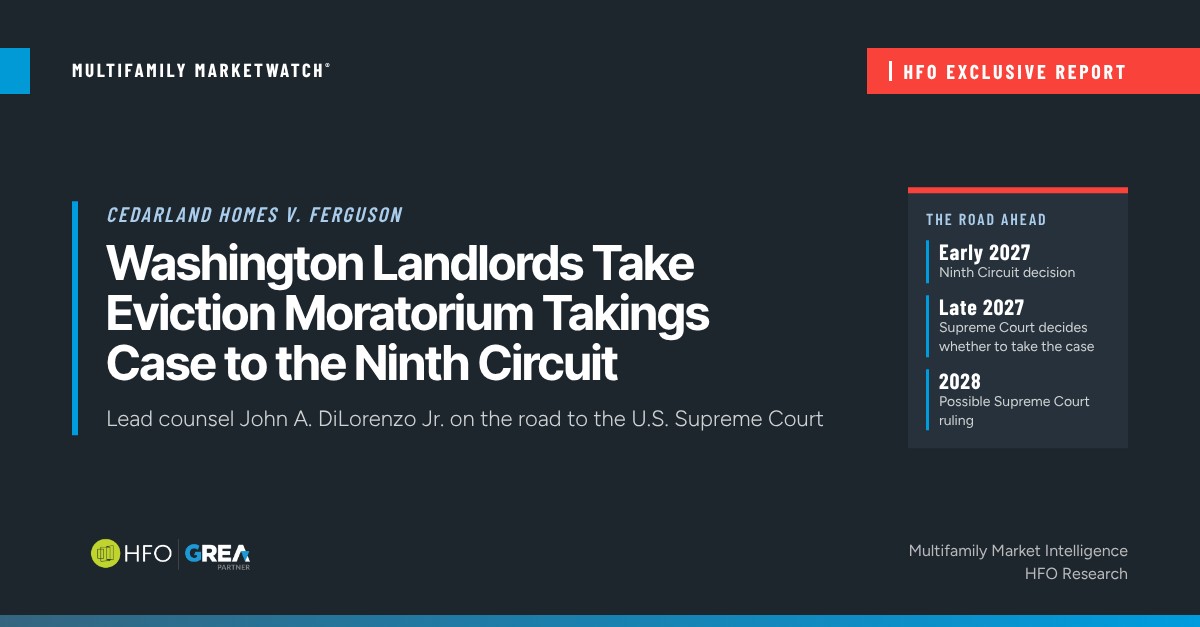
DiLorenzo’s rough schedule: a Ninth Circuit decision in early 2027, a Supreme Court decision on whether to take the case later that year and, if it does, a ruling in 2028. A win would send the case back to district court to certify the class and prepare for trial or settlement.
He sees two reasons owners should pay attention. The first is money. The second is precedent. “If we allow the government to do this to us once, they will be encouraged to do it again,” he said. A compensation requirement would make the next emergency order a decision with a price tag.
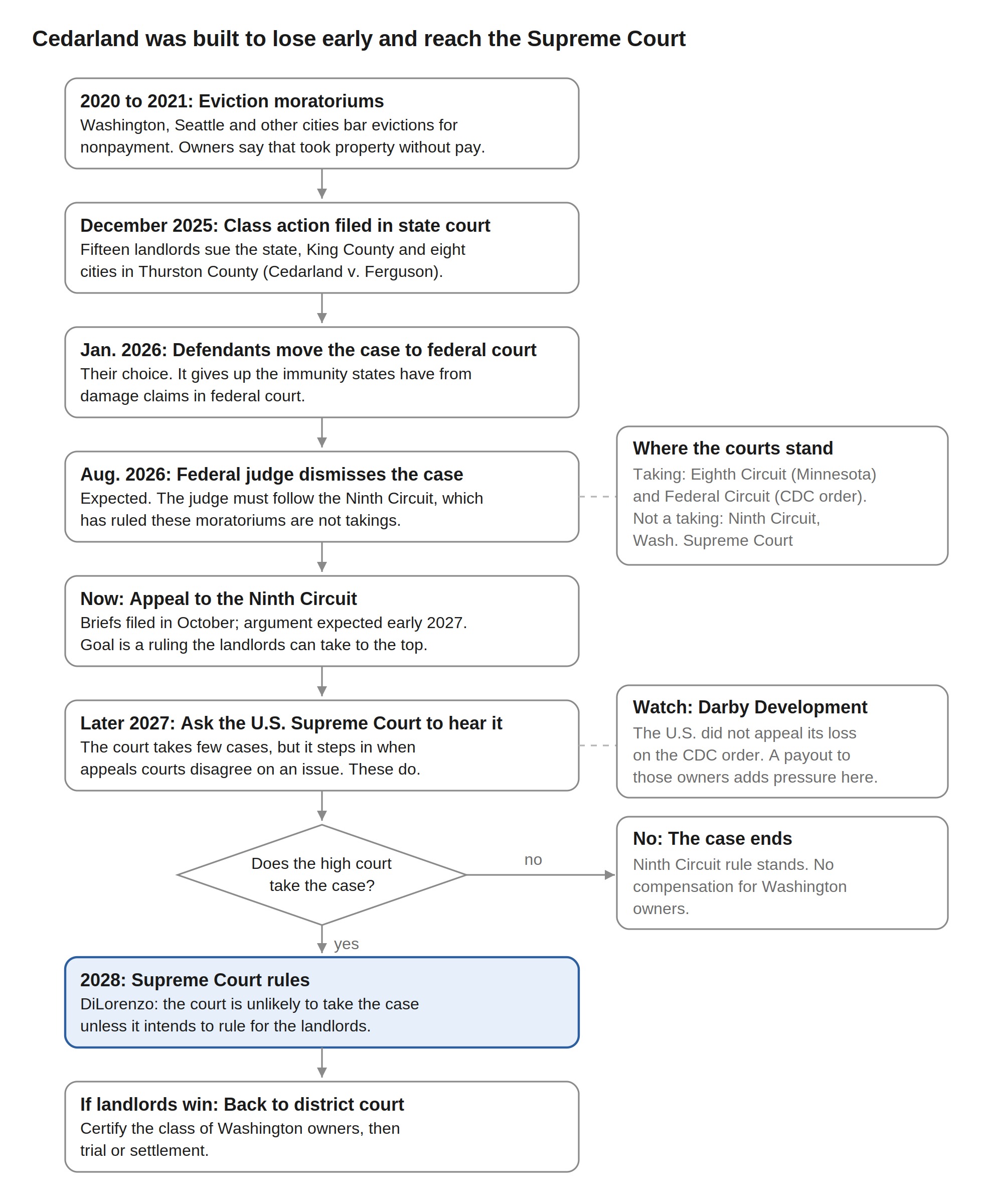
Each loss so far was expected. The case moves up one court at a time toward the only court that can settle the disagreement among the appeals circuits.
The full interview is available on HFO’s Multifamily Marketwatch® channel on YouTube and as a YouTube podcast. HFO Research is the market intelligence arm of HFO Investment Real Estate, the largest multifamily-only brokerage in the Pacific Northwest.
About HFO
HFO Investment Real Estate is the largest multifamily-only brokerage in the Pacific Northwest. The company has 12 brokers focused exclusively on apartment investment sales in Oregon and Washington. Call (503) 241-5541.
- Subscribe to HFO’s Oregon & SW Washington Weekly Newsletter for Multifamily Owners, Investors & Developers on LinkedIn.
- Subscribe to HFO’s Washington State Weekly Newsletter for Multifamily Owners, Investors & Developers on LinkedIn.
- Watch HFO’s latest YouTube interviews and subscribe.
- Click here to read more of our latest investor insights.
- Click here to see many of HFO’s current listings.